


- Retrait en 2 heures
- Assortiment impressionnant
- Paiement sécurisé
- Toujours un magasin près de chez vous
- Retrait en 2 heures
- Assortiment impressionnant
- Paiement sécurisé
- Toujours un magasin près de chez vous



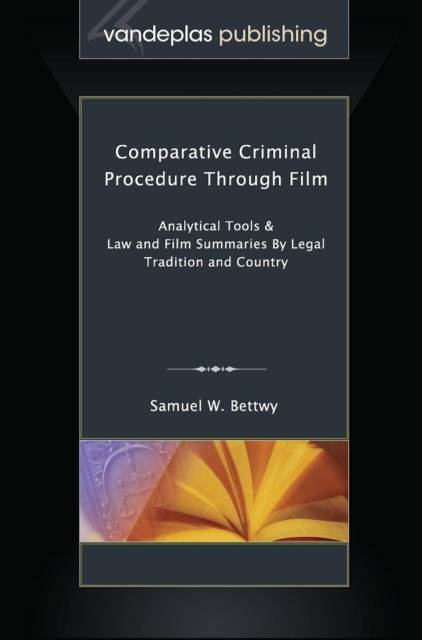
Comparative Criminal Procedure Through Film
Analytical Tools & Law and Film Summaries by Legal Tradition and Country
Samuel W Bettwy
Livre relié | Anglais
104,95 €
+ 209 points
Description
This textbook describes analytical tools for studying comparative criminal procedure through film and provides summaries of the law of 50 countries and of over 270 films that depict criminal procedure in action in those countries. The traditional tools of comparative analysis include the inquisitorial-adversarial dichotomy, role-specific constructs and the Civil Law-Common Law dichotomy. In addition, differences in criminal procedure can be examined through the socialist, Islamic and indigenous legal traditions and through the evolving international legal regimes. The tools of comparative legal analysis are applied to examine the adjudicative process through film, beginning with police contact with a crime suspect and ending either with a judge or jury's acquittal or with execution of sentence. The law summaries describe the distinctive criminal procedure of each legal tradition and of each country within those traditions. For each country, the film summaries describe background information about the film and the filmmaker, the plot of the film as a whole and the legal story contained within. The textbook is designed for teaching law students, but is also suitable for teaching an undergraduate or post-graduate college course in comparative criminal justice. About the author: Samuel W. Bettwy is Adjunct Professor of Law at Thomas Jefferson School of Law, where he has taught Comparative Law since 1995. Professor Bettwy received a J.D. from California Western School of Law, an LL.M. in International and Comparative Law from Georgetown University Law Center, and an M.A. in National Security and Strategic Studies, with highest distinction, from the U.S. Naval War College. In 2009, he graduated from the French Army Reserve Staff Officer Course at l'Ecole Militaire in Paris, France. Professor Bettwy has served as a litigating attorney for the U.S. Department of Justice since 1987, practicing in immigration court, U.S. district court, and the Ninth Circuit Court of Appeals. He also served as a Judge Advocate in the U.S. Army Reserve from 1987 to 2014, retiring as a lieutenant colonel. Professor Bettwy has written several published articles on comparative law, international law, immigration law, terrorism and film."
Spécifications
Parties prenantes
- Auteur(s) :
- Editeur:
Contenu
- Nombre de pages :
- 546
- Langue:
- Anglais
Caractéristiques
- EAN:
- 9781600422591
- Date de parution :
- 29-06-15
- Format:
- Livre relié
- Format numérique:
- Genaaid
- Dimensions :
- 170 mm x 244 mm
- Poids :
- 1061 g


Seulement chez Librairie Club
+ 209 points sur votre carte client de Librairie Club
Cadeau


Les avis
Nous publions uniquement les avis qui respectent les conditions requises. Consultez nos conditions pour les avis.