


- Retrait en 2 heures
- Assortiment impressionnant
- Paiement sécurisé
- Toujours un magasin près de chez vous
- Retrait en 2 heures
- Assortiment impressionnant
- Paiement sécurisé
- Toujours un magasin près de chez vous



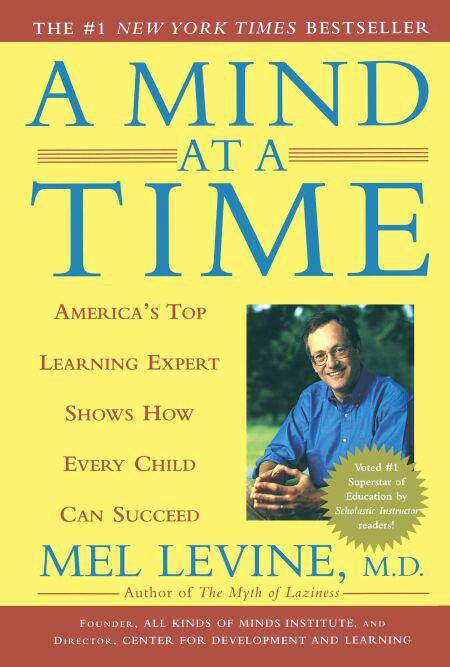
A Mind at a Time EBOOK
America's Top Learning Expert Shows How Every Child Can Succeed
Mel Levine
Ebook | Anglais
17,88 €
+ 17 points
Format
Passer une commande en un clic
Payer en toute sécurité


Livré immédiatement par e-mail
Description
"Different minds learn differently," writes Dr. Mel Levine, one of the best-known education experts and pediatricians in America today. And that's a problem for many children, because most schools still cling to a one-size-fits-all education philosophy. As a result, these children struggle because their learning patterns don't fit the schools they are in.
In A Mind at a Time, Dr. Levine shows parents and others who care for children how to identify these individual learning patterns. He explains how parents and teachers can encourage a child's strengths and bypass the child's weaknesses. This type of teaching produces satisfaction and achievement instead of frustration and failure.
Different brains are differently wired, Dr. Levine explains. There are eight fundamental systems, or components, of learning that draw on a variety of neurodevelopmental capacities. Some students are strong in certain areas and some are strong in others, but no one is equally capable in all eight. Using examples drawn from his own extensive experience, Dr. Levine shows how parents and children can identify their strengths and weaknesses to determine their individual learning styles.
For example, some students are creative and write imaginatively but do poorly in history because weak memory skills prevent them from retaining facts. Some students are weak in sequential ordering and can't follow directions. They may test poorly and often don't do well in mathematics. In these cases, Dr. Levine observes, the problem is not a lack of intelligence but a learning style that doesn't fit the assignment. Drawing on his pioneering research and his work with thousands of students, Dr. Levine shows how parents and teachers can develop effective strategies to work through or around these weaknesses.
"It's taken for granted in adult society that we cannot all be 'generalists' skilled in every area of learning and mastery. Nevertheless, we apply tremendous pressure to our children to be good at everything. They are expected to shine in math, reading, writing, speaking, spelling, memorization, comprehension, problem solving...and none of us adults can" do all this, observes Dr. Levine. Learning begins in school but it doesn't end there. Frustrating a child's desire to learn will have lifelong repercussions. This frustration can be avoided if we understand that not every child can do equally well in every type of learning. We must begin to pay more attention to individual learning styles, to individual minds, urges Dr. Levine, so that we can maximize children's learning potential. In A Mind at a Time he shows us how.
In A Mind at a Time, Dr. Levine shows parents and others who care for children how to identify these individual learning patterns. He explains how parents and teachers can encourage a child's strengths and bypass the child's weaknesses. This type of teaching produces satisfaction and achievement instead of frustration and failure.
Different brains are differently wired, Dr. Levine explains. There are eight fundamental systems, or components, of learning that draw on a variety of neurodevelopmental capacities. Some students are strong in certain areas and some are strong in others, but no one is equally capable in all eight. Using examples drawn from his own extensive experience, Dr. Levine shows how parents and children can identify their strengths and weaknesses to determine their individual learning styles.
For example, some students are creative and write imaginatively but do poorly in history because weak memory skills prevent them from retaining facts. Some students are weak in sequential ordering and can't follow directions. They may test poorly and often don't do well in mathematics. In these cases, Dr. Levine observes, the problem is not a lack of intelligence but a learning style that doesn't fit the assignment. Drawing on his pioneering research and his work with thousands of students, Dr. Levine shows how parents and teachers can develop effective strategies to work through or around these weaknesses.
"It's taken for granted in adult society that we cannot all be 'generalists' skilled in every area of learning and mastery. Nevertheless, we apply tremendous pressure to our children to be good at everything. They are expected to shine in math, reading, writing, speaking, spelling, memorization, comprehension, problem solving...and none of us adults can" do all this, observes Dr. Levine. Learning begins in school but it doesn't end there. Frustrating a child's desire to learn will have lifelong repercussions. This frustration can be avoided if we understand that not every child can do equally well in every type of learning. We must begin to pay more attention to individual learning styles, to individual minds, urges Dr. Levine, so that we can maximize children's learning potential. In A Mind at a Time he shows us how.
Spécifications
Parties prenantes
- Auteur(s) :
- Editeur:
Contenu
- Nombre de pages :
- 352
- Langue:
- Anglais
Caractéristiques
- EAN:
- 9780743217682
- Date de parution :
- 03-04-02
- Format:
- Ebook
- Protection digitale:
- Adobe DRM
- Format numérique:
- ePub


Seulement chez Librairie Club
+ 17 points sur votre carte client de Librairie Club
Cadeau

Cadeau


Les avis
Nous publions uniquement les avis qui respectent les conditions requises. Consultez nos conditions pour les avis.