


En raison d'une grève chez bpost, votre colis sera expédié par GLS afin d’assurer une livraison dans les meilleurs délais.
- Retrait en 2 heures
- Assortiment impressionnant
- Paiement sécurisé
- Toujours un magasin près de chez vous
En raison d'une grève chez bpost, votre colis sera expédié par GLS afin d’assurer une livraison dans les meilleurs délais.
- Retrait en 2 heures
- Assortiment impressionnant
- Paiement sécurisé
- Toujours un magasin près de chez vous



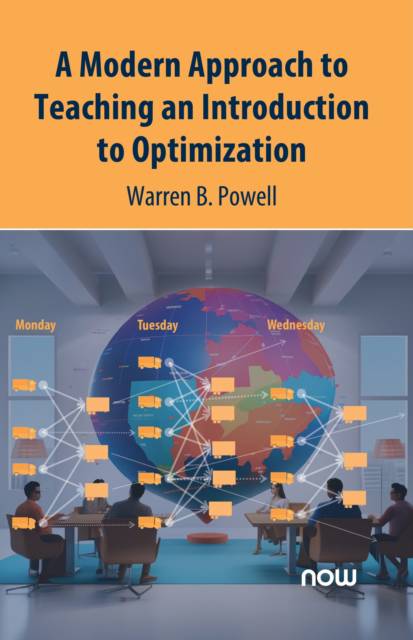
A Modern Approach to Teaching an Introduction to Optimization
William B Powell
Livre relié | Anglais
112,95 €
+ 225 points
Description
Optimization should be the science of making the best possible decisions. Making decisions is a virtually universal human activity encountered by professionals (in any field) or people in their everyday lives. You would think, then, that the study of making good decisions is a subject that should be taught broadly to students throughout engineering, the physical and social sciences, business, and policy. Yet today, "optimization" is widely taught as a mathematically sophisticated subject, often limited to graduate students in specialized fields.
In operations research (or industrial engineering), "optimization" is equivalent to deterministic math programming, starting with linear programs (and the simplex algorithm), and then transitioning through integer linear programs and nonlinear programs. If you are in departments like electrical or mechanical engineering, optimization means teaching optimal control. And if you are in computer science, optimization today could be interpreted in the context of machine learning (such as fitting models to data) or as reinforcement learning.
This book claims that the traditional style of teaching optimization is misguided and out of date. First, while the simplex algorithm is a powerful strategy for solving linear programs, the details of the simplex algorithm are completely inappropriate in an introductory course in optimization. Second, while linear programs are appropriate for solving many problems, they are only applicable to a tiny fraction of all decisions. Third, linear programs (along with integer and nonlinear programs) are static models for problems with (typically) vector-valued decisions. By contrast, most decisions are sequential since they are made periodically over time as new information is arriving. In addition, the vast majority of these decisions are scalar (possibly continuous or discrete).
This book is designed for instructors (or potential instructors) looking to introduce the science of making good decisions to the broadest possible audience. It should also be of interest to anyone who has already had a traditional course in optimization of any type. The presentation is organized around a series of topics that suggest a fundamentally different approach to teaching "optimization" spanning both sequential decision problems (which offer the simplest problem settings) before transitioning to more complex vector-valued decisions. It also makes the case that most problems which are modeled as linear (or integer, or nonlinear programs) are actually methods for making decisions in a sequential setting. For this reason, these topics are introduced with much less emphasis on algorithms than is traditionally used, both in static and sequential settings.
In operations research (or industrial engineering), "optimization" is equivalent to deterministic math programming, starting with linear programs (and the simplex algorithm), and then transitioning through integer linear programs and nonlinear programs. If you are in departments like electrical or mechanical engineering, optimization means teaching optimal control. And if you are in computer science, optimization today could be interpreted in the context of machine learning (such as fitting models to data) or as reinforcement learning.
This book claims that the traditional style of teaching optimization is misguided and out of date. First, while the simplex algorithm is a powerful strategy for solving linear programs, the details of the simplex algorithm are completely inappropriate in an introductory course in optimization. Second, while linear programs are appropriate for solving many problems, they are only applicable to a tiny fraction of all decisions. Third, linear programs (along with integer and nonlinear programs) are static models for problems with (typically) vector-valued decisions. By contrast, most decisions are sequential since they are made periodically over time as new information is arriving. In addition, the vast majority of these decisions are scalar (possibly continuous or discrete).
This book is designed for instructors (or potential instructors) looking to introduce the science of making good decisions to the broadest possible audience. It should also be of interest to anyone who has already had a traditional course in optimization of any type. The presentation is organized around a series of topics that suggest a fundamentally different approach to teaching "optimization" spanning both sequential decision problems (which offer the simplest problem settings) before transitioning to more complex vector-valued decisions. It also makes the case that most problems which are modeled as linear (or integer, or nonlinear programs) are actually methods for making decisions in a sequential setting. For this reason, these topics are introduced with much less emphasis on algorithms than is traditionally used, both in static and sequential settings.
Spécifications
Parties prenantes
- Auteur(s) :
- Editeur:
Contenu
- Nombre de pages :
- 130
- Langue:
- Anglais
Caractéristiques
- EAN:
- 9781638283201
- Date de parution :
- 17-01-24
- Format:
- Livre relié
- Format numérique:
- Genaaid
- Dimensions :
- 156 mm x 234 mm
- Poids :
- 362 g


Seulement chez Librairie Club
+ 225 points sur votre carte client de Librairie Club
Cadeau


Les avis
Nous publions uniquement les avis qui respectent les conditions requises. Consultez nos conditions pour les avis.