


- Retrait en 2 heures
- Assortiment impressionnant
- Paiement sécurisé
- Toujours un magasin près de chez vous
- Retrait gratuit dans votre magasin Club
- 7.000.0000 titres dans notre catalogue
- Payer en toute sécurité
- Toujours un magasin près de chez vous



8,09 €
+ 8 points
Format
Description
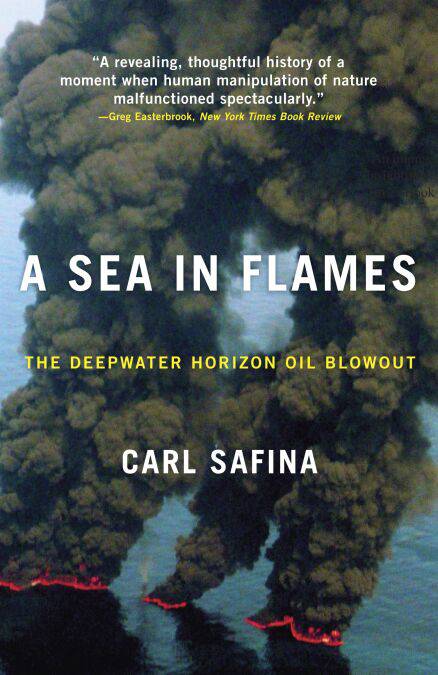
Carl Safina has been hailed as one of the top 100 conservations of the 20th century (Audubon Magazine) and A Sea in Flames is his blistering account of the months-long manmade disaster that tormented a region and mesmerized the nation. Traveling across the Gulf to make sense of an ever-changing story and its often-nonsensical twists, Safina expertly deconstructs the series of calamitous misjudgments that caused the Deepwater Horizon blowout, zeroes in on BP’s misstatements, evasions, and denials, reassesses his own reaction to the government’s crisis handling, and reviews the consequences of the leak—and what he considers the real problems, which the press largely overlooked.
Safina takes us deep inside the faulty thinking that caused the lethal explosion. We join him on aerial surveys across an oil-coated sea. We confront pelicans and other wildlife whose blue universe fades to black. Safina skewers the excuses and the silly jargon—like “junk shot” and “top kill”—that made the tragedy feel like a comedy of horrors—and highlighted Big Oil’s appalling lack of preparedness for an event that was inevitable.
Based on extensive research and interviews with fishermen, coastal residents, biologists, and government officials, A Sea In Flames has some surprising answers on whether it was “Obama’s Katrina,” whether the Coast Guard was as inept in its response as BP was misleading, and whether this worst unintended release of oil in history was really America’s worst ecological disaster.
Impassioned, moving, and even sharply funny, A Sea in Flames is ultimately an indictment of America’s main addiction. Safina writes: “In the end, this is a chronicle of a summer of pain—and hope. Hope that the full potential of this catastrophe would not materialize, hope that the harm done would heal faster than feared, and hope that even if we didn’t suffer the absolutely worst—we’d still learn the big lesson here. We may have gotten two out of three. That’s not good enough. Because: there’ll be a next time.”
Safina takes us deep inside the faulty thinking that caused the lethal explosion. We join him on aerial surveys across an oil-coated sea. We confront pelicans and other wildlife whose blue universe fades to black. Safina skewers the excuses and the silly jargon—like “junk shot” and “top kill”—that made the tragedy feel like a comedy of horrors—and highlighted Big Oil’s appalling lack of preparedness for an event that was inevitable.
Based on extensive research and interviews with fishermen, coastal residents, biologists, and government officials, A Sea In Flames has some surprising answers on whether it was “Obama’s Katrina,” whether the Coast Guard was as inept in its response as BP was misleading, and whether this worst unintended release of oil in history was really America’s worst ecological disaster.
Impassioned, moving, and even sharply funny, A Sea in Flames is ultimately an indictment of America’s main addiction. Safina writes: “In the end, this is a chronicle of a summer of pain—and hope. Hope that the full potential of this catastrophe would not materialize, hope that the harm done would heal faster than feared, and hope that even if we didn’t suffer the absolutely worst—we’d still learn the big lesson here. We may have gotten two out of three. That’s not good enough. Because: there’ll be a next time.”
Spécifications
Parties prenantes
- Auteur(s) :
- Editeur:
Contenu
- Nombre de pages :
- 368
- Langue:
- Anglais
Caractéristiques
- EAN:
- 9780307887375
- Date de parution :
- 18-04-11
- Format:
- Ebook
- Protection digitale:
- Adobe DRM
- Format numérique:
- ePub


Seulement chez Librairie Club
+ 8 points sur votre carte client de Librairie Club

Les avis
Nous publions uniquement les avis qui respectent les conditions requises. Consultez nos conditions pour les avis.