


- Retrait en 2 heures
- Assortiment impressionnant
- Paiement sécurisé
- Toujours un magasin près de chez vous
- Retrait en 2 heures
- Assortiment impressionnant
- Paiement sécurisé
- Toujours un magasin près de chez vous



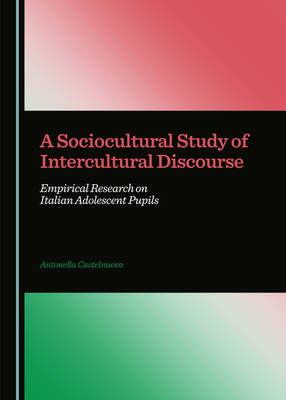
A Sociocultural Study of Intercultural Discourse
Empirical Research on Italian Adolescent Pupils
Antonella Castelnuovo
Livre relié | Anglais
74,45 €
+ 148 points
Description
This book is the result of research which was begun over twenty years ago and which spanned two countries, as well as two decades. It developed out of the author's work in speech therapy, but took on the in-depth theoretical investigation of the work of Bernstein, Vygotsky, Luria, and Hallidayan linguistics in an investigation of ways of thinking and the use of language, and particularly the relationship between group processes and individual learning. This research project did not remain within the realms of theory as it began to study developmental patterns which may be helpful in informing pedagogy, leading to this book, which gathers together real data and actual language use in the classroom. Rather like the sampling of water from a river by plunging in a test tube, this book provides a sample which is full of micro-elements in a medium which is a rich and complex context, full of variables, contextual variation and trace elements of sociocultural diversity. The small sample analysed in the book, taken from classroom data gathered in a small town in Tuscany and a small group of adolescents, and put under the microscope of quantitative and qualitative analysis involving multiple tests regarding various linguistic and socio-cultural elements, is testament to the complexity of such a setting and the nature of classroom interaction. The complex interactions between theory and practice, and between individual consciousness and socially organised experience are laid out in detail throughout the book, which offers both wide ranging and in-depth theoretical analysis of the relevant literature and insights into the careful sampling procedures used in the classroom all brought together to provide up-to-date and detailed information for teachers and to highlight aspects of diversity in the appropriation of cultural tools. The book can be read in two different ways, each one of them informative in itself. For those interested in socio-culturally informed theories of language, this book will serve as a guide to the relationships between three possible approaches: namely, the sociological approach of Basil Bernstein, the cultural-historical approach of Lev Vygotsky, and the linguistic approach of Michael Halliday. For those interested in empirical analysis of discourses produced by adolescents from different cultural and socio-economic backgrounds, the book provides rich material about language use by Italian and immigrant youth.
Spécifications
Parties prenantes
- Auteur(s) :
- Editeur:
Contenu
- Nombre de pages :
- 310
- Langue:
- Anglais
Caractéristiques
- EAN:
- 9781443872003
- Date de parution :
- 31-07-15
- Format:
- Livre relié
- Format numérique:
- Genaaid
- Dimensions :
- 140 mm x 221 mm
- Poids :
- 385 g


Seulement chez Librairie Club
+ 148 points sur votre carte client de Librairie Club
Cadeau


Les avis
Nous publions uniquement les avis qui respectent les conditions requises. Consultez nos conditions pour les avis.