


- Retrait en 2 heures
- Assortiment impressionnant
- Paiement sécurisé
- Toujours un magasin près de chez vous
- Retrait en 2 heures
- Assortiment impressionnant
- Paiement sécurisé
- Toujours un magasin près de chez vous



34,95 €
+ 69 points
Format
Description
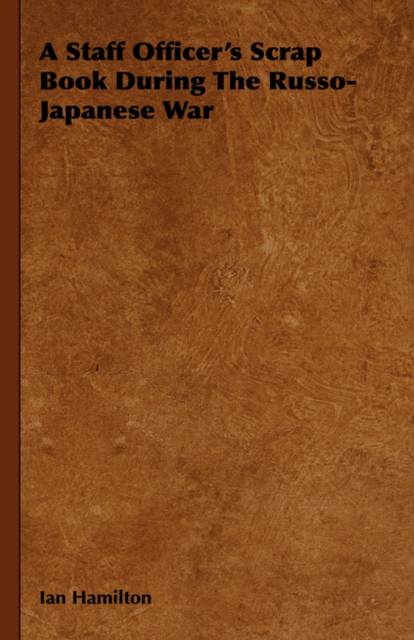
A STAFF OFFICERS SCRAP-BOOK DURING THE RUSSO-JAPANESE WAR by SIR IAN HAMILTON, K. C. B. WITH ILLUSTRATIONS, MAPS AND PLANS. Originally published in 1906. PREFACE: IT is difficult to convey to the peaceable citizens of Greater Britain a true picture of that glorious and impressive survival from heroic times, a nation in arms. The difficulty is enhanced by the fact that military history must be always to some extent misleading. If facts are hurriedly issued, fresh from the mint of battle, they cannot be expected to supply an account which is either well balanced or exhaustive. On the other hand, it is equally certain that, when once the fight has been fairly lost or won, it is the tendency of all ranks to combine and recast the story of their achievement into a shape which shall satisfy the susceptibilities of national and regimental vain glory. It is then already too late for the painstaking historian to set to work. He may record the orders given and the movements which ensued, and lie may build up thereon any ingenious theories which occur to him but to the hopes and fears which dictated those orders, and to the spirit and method in which those movements were executed, he has for ever lost the clue. On the actual da r of battle naked truths may be picked up for the asking by the following morning they have already begun to get into their uniforms. If the impressions here recorded possess any value, it will be because they do faithfully represent the facts as they appeared to the First Japanese Army while the wounded still lay bleeding upon the stricken field. Further than this they do not profess to go. The time has hardly yet come for a full and critical account by an ex-attache of a war round which so many conflicting national ambitions have revolved. Meanwhile these scraps, snap-shots, by-products, or whatever they may be called, are offered to the public in the hope that they may interest, without hurting the feelings of either of the great armies concerned. If this hope should be realised, I shall be encouraged to advance with Kuroki through conflicts fiercer and bloodier far than any I have here attempted to set down. My special thanks are due to Captain Vincent for the help he has given me, and for the maps, sketches and photographs with which the volume is illustrated. It is hardly necessary for rne here to acknowledge my indebtedness to my kind hosts, or to other British attaches, for this will become patent to the reader as he reads. TAX HAMILTON. Contents include: CHAPTER 1 . PAGE I. FIRST IMPRESSIONS OF THE JAPANESE ARMY ... 1 II. SOME NEW ACQUAINTANCES 1 J III. THREE PLEASING TRAITS 36 IV. FROM TOKIO TO THE YALU 44 V. FENGHUANGCIIENG 64 VI. THE POSITION ON THE YAH . .... 73 VII. THE BATTLE OF THE YALU 97 VIII. THE ATTACHES ARE ENTERTAINED . ... 140 IX. THE CHINESE GENERAL PAYS A VISIT . . 161 X. GENERAL FUJII TALKS 180 XI. THE FEAST OF THE DEAD 193 XII. ON THE MARCH AT LAST 210 XIII. AN AFFAIR OF OUTPOSTS 230 XIV. THE BATTLE OF THE HKAVEN-REACHJNG PASS, . 253 XV. CHAOTAO 280 XVI. A PAUSE BEFORE THE ADVANCE 302 XVII. THE BATTLE OF YUSHIKEI. i315 KVI11. THE DISASTROUS RETREAT FKOM PENLIN . . . 330 ILLUSTRATIONS MAPS AND SKETCHES I. General Map of Korea and Manchuria . .... At end II. Map of the Battle of the Yalu To face page 134 III. Map of the Fight at Hamaton, 126 IV. Panorama of the Battle of the Yalu from Wiju . 90 V. Panorama of Fenghuangcheng 174 VI. View of the Motienling Range from a Mountain above Lienshankuan 234 VII. The First Russian Attack on the Motienling, July 4th, 1904 23 x ILLUSTRATIONS VIII. View of the Motienling from the Old Temple, in con nection with the Second Russian Attack on July 17th, 1904 To face page 274 IX. Plan of the Battle of Motienling, July 17th, 1904 . . 276 X. Plan of the Fight of the 16th Regiment on July 17th, 1904 ..., 278 XI...
Spécifications
Parties prenantes
- Auteur(s) :
- Editeur:
Contenu
- Nombre de pages :
- 424
- Langue:
- Anglais
Caractéristiques
- EAN:
- 9781443731263
- Date de parution :
- 04-11-08
- Format:
- Livre relié
- Format numérique:
- Genaaid
- Dimensions :
- 140 mm x 216 mm
- Poids :
- 684 g



Seulement chez Librairie Club
+ 69 points sur votre carte client de Librairie Club
Cadeau


Les avis
Nous publions uniquement les avis qui respectent les conditions requises. Consultez nos conditions pour les avis.