


- Retrait en 2 heures
- Assortiment impressionnant
- Paiement sécurisé
- Toujours un magasin près de chez vous
- Retrait gratuit dans votre magasin Club
- 7.000.0000 titres dans notre catalogue
- Payer en toute sécurité
- Toujours un magasin près de chez vous



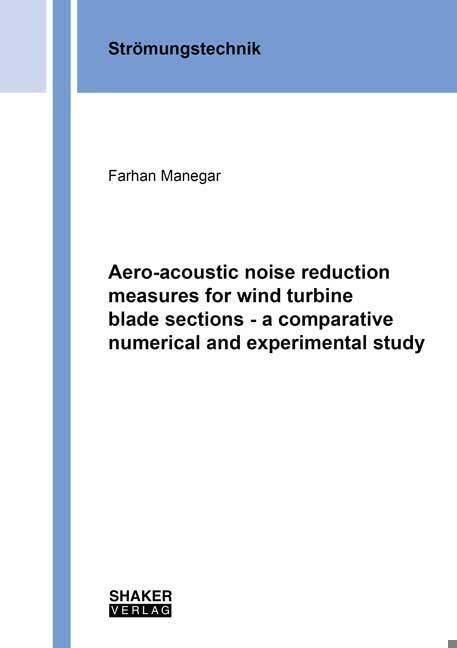
Aero-acoustic noise reduction measures for wind turbine blade sections - a comparative numerical and experimental study
Dissertationsschrift
Farhan Manegar
45,45 €
+ 90 points
Description
The noise emitted by wind turbines are caused due to different mechanisms. The dominant mechanism behind the aerodynamic noise emitted is the interaction between the turbulent boundary layer developing over the blade surface near the trailing edge and the trailing edge itself. The overall objective of this thesis is to investigate and assess three different trailing edge noise reduction measures on an undistorted airfoil section: a) trailing edge blowing (TEB) on the suction side using secondary air unit, b) attachment of trailing edge serrations (TES) and c) porous trailing edge (PTE). The main investigation tool used is the numerical Lattice BOLTZMANN method. The simulation results are extensively validated with numerous experimentally measured flow-field and acoustic results.The three noise reduction measures show a similar effect: In comparison to the untreated airfoil, the far-field noise spectrum shows noise reduction in the low to mid frequency range, but also an increase in noise at higher frequencies. On numerical analysis of TEB, it is revealed that the blowing jet blows away the larger turbulent structures in the turbulent boundary layer, thereby reducing the noise. As an additional analysis, the LAGRANGIAN coherent structures are extracted from the flow-field. A resulting smaller boundary layer, which develops after the blowing slot, induces KÁRMÁN type vortex shedding, which explains the increase of high frequency noise. TES are acoustically very effective, when the coherent structures along the top and bottom edges of TES mix well with each other. The noise reduction observed in the simulation and experiment of PTE is attributed to the flow-field communication between the suction and pressure sides of the porous regions of the airfoil.
Spécifications
Parties prenantes
- Auteur(s) :
- Editeur:
Contenu
- Nombre de pages :
- 117
- Langue:
- Anglais
- Collection :
Caractéristiques
- EAN:
- 9783844078640
- Format:
- Livre broché
- Dimensions :
- 172 mm x 7 mm
- Poids :
- 176 g


Seulement chez Librairie Club
+ 90 points sur votre carte client de Librairie Club

Les avis
Nous publions uniquement les avis qui respectent les conditions requises. Consultez nos conditions pour les avis.