


- Retrait en 2 heures
- Assortiment impressionnant
- Paiement sécurisé
- Toujours un magasin près de chez vous
- Retrait en 2 heures
- Assortiment impressionnant
- Paiement sécurisé
- Toujours un magasin près de chez vous



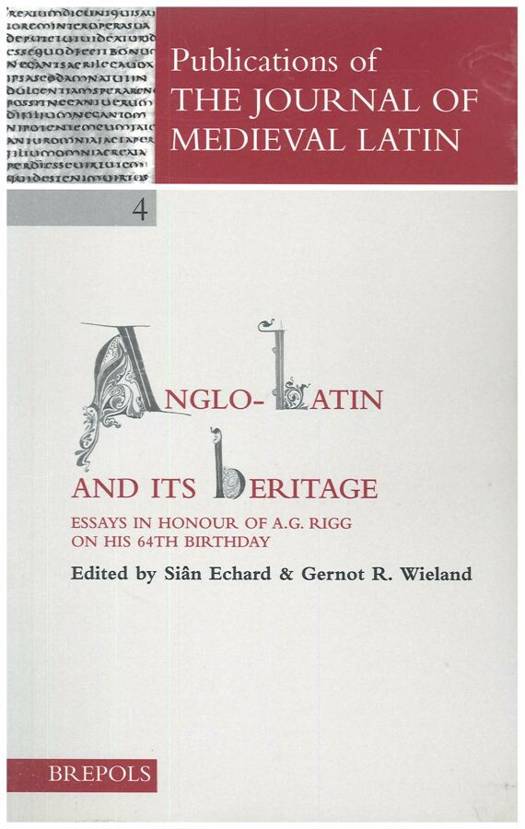
Anglo-Latin and its Heritage
S. Echard
31,80 €
+ 63 points
Description
For some 40 years, A.G. Rigg has been defining the field of later Anglo-Latin scholarship, a task culminating in his History of Anglo-Latin Literature 1066-1422. 'Anglo-Latin and its Heritage' is a collection of thirteen essays by his colleagues and students, past and present, which pays tribute to him both by exploring the field he has defined, and by making forays into its antecedents and descendants. The first section, Roots and Debts, includes essays on the migration of classical and late antique motifs and patterns of thought into early medieval Latin, and concludes with an essay which shows how a 12th-century writer reached back into that earlier period for stylistic models. The central section of the book, Anglo-Latin Literature 1066-1422, concentrates on Anglo-Latin writers of the period most studied by Rigg himself, and the seven essays in this section include analyses of poetic style and borrowing discussions of patterns of reading and essays which read Anglo-Latin works through their specific historical and cultural contexts. Two of the essays are elegant translations of significant Anglo-Latin poetic works. The final section of the book, Influence and Survival, offers three essays which consider Anglo-Latin literature in the late medieval and post-medieval world, from an edition of a Latin source for a late Middle English saint's life through an account of the migration of Latin texts into the royal libraries of Henry VIII to the concluding essay, which explores a mechanical means of producing perfect Latin hexameter. A complete bibliography of Rigg's works closes the volume. The chronological and methodological range of the essays in this collection is offered as a fitting tribute to one of Anglo-Latin's most learned and indefatigable scholars.
Spécifications
Parties prenantes
- Auteur(s) :
- Editeur:
Contenu
- Nombre de pages :
- 298
- Langue:
- Français
- Collection :
- Tome:
- n° 4
Caractéristiques
- EAN:
- 9782503508382
- Date de parution :
- 02-03-01
- Format:
- Livre broché
- Format numérique:
- Trade paperback (VS)
- Dimensions :
- 160 mm x 256 mm
- Poids :
- 560 g


Seulement chez Librairie Club
+ 63 points sur votre carte client de Librairie Club
Cadeau


Les avis
Nous publions uniquement les avis qui respectent les conditions requises. Consultez nos conditions pour les avis.