


- Retrait en 2 heures
- Assortiment impressionnant
- Paiement sécurisé
- Toujours un magasin près de chez vous
- Retrait gratuit dans votre magasin Club
- 7.000.0000 titres dans notre catalogue
- Payer en toute sécurité
- Toujours un magasin près de chez vous


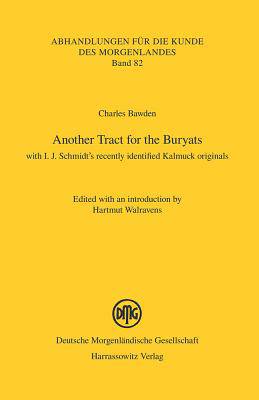
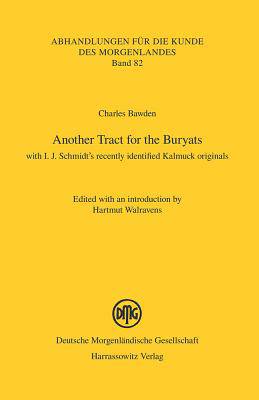
Another Tract for the Buryats
Including I. J. Schmidt's Recentlly Identified Kalmuck Originals
Charles R Bawden
Livre broché | Anglais
88,95 €
+ 177 points
Description
Christian mission among the Mongols and the beginning of Mongolian Studies were closely affiliated. Europe's first Mongolist, Isaak Jakob Schmidt (1779-1847), rose from the humble position of a clerk at the Moravian Mission settlement at Sarepta (Russia) to a member of the St. Petersburg Academy of Sciences. Author of a Mongolian dictionary, a Mongolian grammar and translator of the Geser epic and the chronicle Erdeni-yin tobci, he was also the translator of the New Testament into Mongolian. So far it was assumed that Schmidt had mainly translated into Kalmuck, and two Mongolian nobles had then continued with the further translation into Eastern Mongol. A few years ago Charles Bawden edited and translated a new document found in the library of the German Oriental Society at Halle, the first Christian tract printed in Mongol in St. Petersburg in 1818. The present study focuses on a second tract (probably also 1818) by Schmidt, so far unknown, from the collections of Vilnius University, and includes two of the original versions in Kalmuck which were also tracked down. These tracts allow a closer look at the difficult work of the translator, a glimpse at his workshop, in his efforts to find a congenial rendering for Christian terms. In the light of the results of this study the roles of the translators may have to be reevaluated. There is also an essay to investigate the creation of Kalmuck and Mongolian fonts and the part that the publisher and printer Grec and the Orientalist printing pioneer Schilling von Canstadt (1786-1837) played in it. Transliteration and reproduction of the (Mongol and Kalmuck) tracts and an annotated translation of the second Tract for the Buryats are given as well.
Spécifications
Parties prenantes
- Auteur(s) :
- Editeur:
Contenu
- Nombre de pages :
- 131
- Langue:
- Anglais
Caractéristiques
- EAN:
- 9783447068314
- Date de parution :
- 01-12-12
- Format:
- Livre broché
- Format numérique:
- Trade paperback (VS)
- Dimensions :
- 145 mm x 218 mm
- Poids :
- 225 g


Seulement chez Librairie Club
+ 177 points sur votre carte client de Librairie Club

Les avis
Nous publions uniquement les avis qui respectent les conditions requises. Consultez nos conditions pour les avis.