


- Retrait en 2 heures
- Assortiment impressionnant
- Paiement sécurisé
- Toujours un magasin près de chez vous
- Retrait en 2 heures
- Assortiment impressionnant
- Paiement sécurisé
- Toujours un magasin près de chez vous



35,95 €
+ 71 points
Description
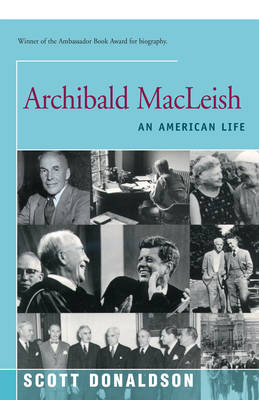
"Poet, lawyer, Librarian of Congress, statesman, and professor, MacLeish (1892-1982) revived the Homeric ideal of a poet as "a man in the world." In this authorized and idealized biography, his only flaws are a demanding nature, many discreet infidelities, and lack of interest in his children. Fortunately, Donaldson . . . is as successful in celebrating MacLeish's strengths as he has been in tracing the demons that destroyed Cheever . . . Fitzgerald, and Hemingway. Born into a wealthy Illinois family, MacLeish attended Yale and Harvard Law, married his childhood sweetheart, and moved to Paris, where he joined the circle around Joyce and Hemingway (his lifelong friend) and, sustained by family resources, devoted himself to poetry. Returning to N.Y.C., he spent the 30's editing and writing for Fortune magazine while producing radio and stage plays (starring the young Orson Welles) that expressed his liberal politics. In the 40's, MacLeish served as the first Librarian of Congress, then as Secretary of State for Cultural Affairs, and, after helping to write the preamble to the UN Charter, worked for UNESCO. Even after accepting a Harvard professorship in 1946, he remained a mediator between the worlds of art and of public life, urging the release of Ezra Pound from his mental asylum and publishing, the day after the first moon landing, a celebratory poem on the front page of The New York Times. MacLeish's last years were spent lecturing, traveling, gathering prizes, entertaining friends (including Richard Burton and Liz Taylor), and writing dramas, as well as private but unrevealing poems about old age, his various affairs, and the bliss he found in his marriage. For such a long and spectacular life, this is a spare and unpretentious biography, like MacLeish's verse. Donaldson is informed, respectful, and comfortable with the many different roles his subject played. He tastefully draws on unpublished verse to illuminate the shadows--but mostly, like MacLeish himself, stays in the light." --Library Journal
Spécifications
Parties prenantes
- Auteur(s) :
- Editeur:
Contenu
- Nombre de pages :
- 672
- Langue:
- Anglais
Caractéristiques
- EAN:
- 9781504030021
- Date de parution :
- 27-09-2016
- Format:
- Livre broché
- Format numérique:
- Trade paperback (VS)
- Dimensions :
- 152 mm x 229 mm
- Poids :
- 970 g


Seulement chez Librairie Club
+ 71 points sur votre carte client de Librairie Club
Cadeau


Les avis
Nous publions uniquement les avis qui respectent les conditions requises. Consultez nos conditions pour les avis.