


- Retrait en 2 heures
- Assortiment impressionnant
- Paiement sécurisé
- Toujours un magasin près de chez vous
- Retrait en 2 heures
- Assortiment impressionnant
- Paiement sécurisé
- Toujours un magasin près de chez vous



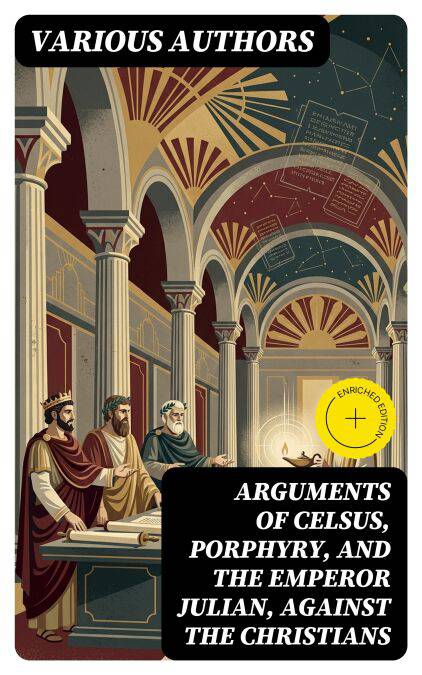
Arguments of Celsus, Porphyry, and the Emperor Julian, Against the Christians EBOOK
Enriched edition. Also Extracts from Diodorus Siculus, Josephus, and Tacitus, Relating to the Jews, Together with an Appendix
Cornelius Tacitus, Flavius Josephus, Emperor of Rome Julian, Siculus Diodorus, Porphyry, Active 180 Celsus
Ebook | Anglais
0,49 €
Format
Description
In the fascinating anthology "Arguments of Celsus, Porphyry, and the Emperor Julian, Against the Christians," readers will encounter a unique exploration of early theological and philosophical critiques directed at Christianity during the formative years of the Roman Empire. This collection deftly assembles a spectrum of literary styles that range from philosophical discourse to historical documentation. It highlights the intellectual rigor and diverse literary strategies that these thinkers employed to examine and often contest the foundational premises of Christian doctrine. From the rhetorical nuance in Celsus to the historical scrutiny of Porphyry, the anthology systematically presents a thought-provoking dialogue that remains significant in understanding the religious and philosophical landscape of antiquity. The contributors to this compelling collection, Cornelius Tacitus, Flavius Josephus, Emperor Julian, Siculus Diodorus, Porphyry, and Celsus, are luminaries each with a profound impact on the intellectual conversations of their time. Together, these scholars and figures align closely with the intellectual and cultural movements of the Roman and Hellenistic worlds. The anthology brings together voices from historians to emperors, creating a comprehensive narrative that explores opposition to Christian thought through diverse societal lenses, bridging pagan and imperial perspectives with historical endurance. Readers are invited to delve into this volume to engage with its rich tapestry of perspectives, enabling a nuanced understanding of historical debates surrounding Christianity's ascent. The anthology's educational value is inestimable, offering insights into the era's complex interreligious dynamics and philosophical inquiries. By studying these collected works, modern readers can appreciate the ongoing dialogue between historical critiques and religious narratives that continue to resonate in contemporary discourse.
In this enriched edition, we have carefully created added value for your reading experience:
- An Introduction draws the threads together, discussing why these diverse authors and texts belong in one collection.
- Historical Context explores the cultural and intellectual currents that shaped these works, offering insight into the shared (or contrasting) eras that influenced each writer.
- A combined Synopsis (Selection) briefly outlines the key plots or arguments of the included pieces, helping readers grasp the anthology's overall scope without giving away essential twists.
- A collective Analysis highlights common themes, stylistic variations, and significant crossovers in tone and technique, tying together writers from different backgrounds.
- Reflection questions encourage readers to compare the different voices and perspectives within the collection, fostering a richer understanding of the overarching conversation.
In this enriched edition, we have carefully created added value for your reading experience:
- An Introduction draws the threads together, discussing why these diverse authors and texts belong in one collection.
- Historical Context explores the cultural and intellectual currents that shaped these works, offering insight into the shared (or contrasting) eras that influenced each writer.
- A combined Synopsis (Selection) briefly outlines the key plots or arguments of the included pieces, helping readers grasp the anthology's overall scope without giving away essential twists.
- A collective Analysis highlights common themes, stylistic variations, and significant crossovers in tone and technique, tying together writers from different backgrounds.
- Reflection questions encourage readers to compare the different voices and perspectives within the collection, fostering a richer understanding of the overarching conversation.
Spécifications
Parties prenantes
- Auteur(s) :
- Editeur:
Contenu
- Nombre de pages :
- 71
- Langue:
- Anglais
Caractéristiques
- EAN:
- 8596547010456
- Date de parution :
- 27-05-22
- Format:
- Ebook
- Protection digitale:
- Digital watermarking
- Format numérique:
- ePub


Seulement chez Librairie Club
Cadeau


Les avis
Nous publions uniquement les avis qui respectent les conditions requises. Consultez nos conditions pour les avis.