


- Retrait en 2 heures
- Assortiment impressionnant
- Paiement sécurisé
- Toujours un magasin près de chez vous
- Retrait gratuit dans votre magasin Club
- 7.000.0000 titres dans notre catalogue
- Payer en toute sécurité
- Toujours un magasin près de chez vous



126,45 €
+ 252 points
Description
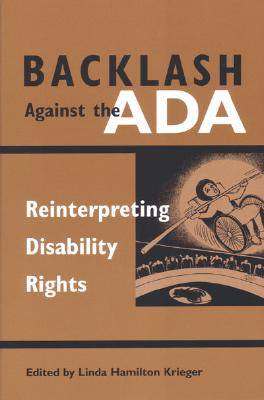
For civil rights lawyers who toiled through the 1980s in the increasingly barren fields of race and sex discrimination law, the approval of the Americans with Disabilities Act in 1990 by a nearly unanimous U.S. House and Senate and a Republican President seemed almost fantastic. Within five years of the Act's effective date, however, observers were warning of an unfolding assault on the ADA by federal judges, the media, and other national opinion-makers. A year after the Supreme Court issued a trio of decisions in the summer of 1999 sharply limiting the ADA's reach, another decision invalidated an entire title of the act as it applied to the states. By this time, disability activists and disability rights lawyers were speaking openly of a backlash against the ADA.
What happened, why did it happen, and what can we learn from the patterns of public, media, and judicial response to the ADA that emerged in the 1990s? In this book, a distinguished group of disability activists, disability rights lawyers, social scientists and humanities scholars grapple with these questions. Taken together, these essays construct and illustrate a new and powerful theoretical model of sociolegal change and retrenchment that can inform both the conceptual and theoretical work of scholars and the day-to-day practice of social justice activists.
Contributors include Lennard J. Davis, Matthew Diller, Harlan Hahn, Linda Hamilton Krieger, Vicki A. Laden, Stephen L. Percy, Marta Russell, and Gregory Schwartz.
Backlash Against the ADA will interest disability rights activists, lawyers, law students and legal scholars interested in social justice and social change movements, and students and scholars in disability studies, political science, media studies, American studies, social movement theory, and legal history.
Linda Hamilton Krieger is Professor of Law, University of California School of Law, Berkeley.
What happened, why did it happen, and what can we learn from the patterns of public, media, and judicial response to the ADA that emerged in the 1990s? In this book, a distinguished group of disability activists, disability rights lawyers, social scientists and humanities scholars grapple with these questions. Taken together, these essays construct and illustrate a new and powerful theoretical model of sociolegal change and retrenchment that can inform both the conceptual and theoretical work of scholars and the day-to-day practice of social justice activists.
Contributors include Lennard J. Davis, Matthew Diller, Harlan Hahn, Linda Hamilton Krieger, Vicki A. Laden, Stephen L. Percy, Marta Russell, and Gregory Schwartz.
Backlash Against the ADA will interest disability rights activists, lawyers, law students and legal scholars interested in social justice and social change movements, and students and scholars in disability studies, political science, media studies, American studies, social movement theory, and legal history.
Linda Hamilton Krieger is Professor of Law, University of California School of Law, Berkeley.
Spécifications
Parties prenantes
- Auteur(s) :
- Editeur:
Contenu
- Nombre de pages :
- 376
- Langue:
- Anglais
- Collection :
Caractéristiques
- EAN:
- 9780472098255
- Date de parution :
- 26-03-03
- Format:
- Livre relié
- Format numérique:
- Genaaid
- Dimensions :
- 161 mm x 234 mm
- Poids :
- 680 g


Seulement chez Librairie Club
+ 252 points sur votre carte client de Librairie Club
Cadeau

Cadeau


Les avis
Nous publions uniquement les avis qui respectent les conditions requises. Consultez nos conditions pour les avis.