


- Retrait en 2 heures
- Assortiment impressionnant
- Paiement sécurisé
- Toujours un magasin près de chez vous
- Retrait gratuit dans votre magasin Club
- 7.000.0000 titres dans notre catalogue
- Payer en toute sécurité
- Toujours un magasin près de chez vous



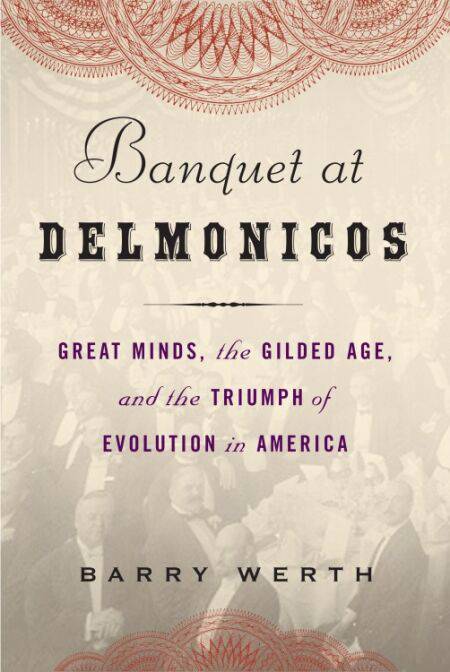
Banquet at Delmonico's EBOOK
Great Minds, the Gilded Age, and the Triumph of Evolution in America
Barry Werth
Ebook | Anglais
8,06 €
Description
In Banquet at Delmonico’s, Barry Werth, the acclaimed author of The Scarlet Professor, draws readers inside the circle of philosophers, scientists, politicians, businessmen, clergymen, and scholars who brought Charles Darwin’s controversial ideas to America in the crucial years after the Civil War.
The United States in the 1870s and ’80s was deep in turmoil–a brash young nation torn by a great depression, mired in scandal and corruption, rocked by crises in government, violently conflicted over science and race, and fired up by spiritual and sexual upheavals. Secularism was rising, most notably in academia. Evolution–and its catchphrase, “survival of the fittest”–animated and guided this Gilded Age.
Darwin’s theory of natural selection was extended to society and morals not by Darwin himself but by the English philosopher Herbert Spencer, father of “the Law of Equal Freedom,” which holds that “every man is free to do that which he wills,” provided it doesn’t infringe on the equal freedom of others. As this justification took root as a social, economic, and ethical doctrine, Spencer won numerous influential American disciples and allies, including industrialist Andrew Carnegie, clergyman Henry Ward Beecher, and political reformer Carl Schurz. Churches, campuses, and newspapers convulsed with debate over the proper role of government in regulating Americans’ behavior, this country’s place among nations, and, most explosively, the question of God’s existence.
In late 1882, most of the main figures who brought about and popularized these developments gathered at Delmonico’s, New York’s most venerable restaurant, in an exclusive farewell dinner to honor Spencer and to toast the social applications of the theory of evolution. It was a historic celebration from which the repercussions still ripple throughout our society.
Banquet at Delmonico’s is social history at its finest, richest, and most appetizing, a brilliant narrative bristling with personal intrigue, tantalizing insights, and greater truths about American life and culture.
The United States in the 1870s and ’80s was deep in turmoil–a brash young nation torn by a great depression, mired in scandal and corruption, rocked by crises in government, violently conflicted over science and race, and fired up by spiritual and sexual upheavals. Secularism was rising, most notably in academia. Evolution–and its catchphrase, “survival of the fittest”–animated and guided this Gilded Age.
Darwin’s theory of natural selection was extended to society and morals not by Darwin himself but by the English philosopher Herbert Spencer, father of “the Law of Equal Freedom,” which holds that “every man is free to do that which he wills,” provided it doesn’t infringe on the equal freedom of others. As this justification took root as a social, economic, and ethical doctrine, Spencer won numerous influential American disciples and allies, including industrialist Andrew Carnegie, clergyman Henry Ward Beecher, and political reformer Carl Schurz. Churches, campuses, and newspapers convulsed with debate over the proper role of government in regulating Americans’ behavior, this country’s place among nations, and, most explosively, the question of God’s existence.
In late 1882, most of the main figures who brought about and popularized these developments gathered at Delmonico’s, New York’s most venerable restaurant, in an exclusive farewell dinner to honor Spencer and to toast the social applications of the theory of evolution. It was a historic celebration from which the repercussions still ripple throughout our society.
Banquet at Delmonico’s is social history at its finest, richest, and most appetizing, a brilliant narrative bristling with personal intrigue, tantalizing insights, and greater truths about American life and culture.
Spécifications
Parties prenantes
- Auteur(s) :
- Editeur:
Contenu
- Nombre de pages :
- 400
- Langue:
- Anglais
Caractéristiques
- EAN:
- 9781588367983
- Date de parution :
- 05-01-09
- Format:
- Ebook
- Protection digitale:
- Adobe DRM
- Format numérique:
- ePub


Seulement chez Librairie Club
Cadeau

Cadeau


Les avis
Nous publions uniquement les avis qui respectent les conditions requises. Consultez nos conditions pour les avis.