


- Retrait en 2 heures
- Assortiment impressionnant
- Paiement sécurisé
- Toujours un magasin près de chez vous
- Retrait en 2 heures
- Assortiment impressionnant
- Paiement sécurisé
- Toujours un magasin près de chez vous



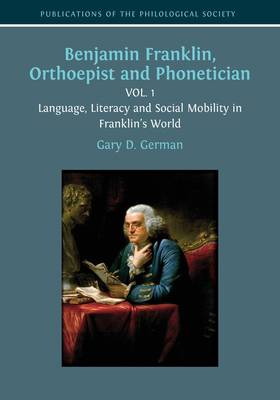
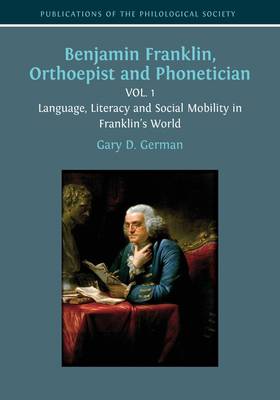
Benjamin Franklin, Orthoepist and Phonetician
Vol. 1: Language, Literacy and Social Mobility in Franklin's World
Gary D German
62,45 €
+ 124 points
Format
Description
Benjamin Franklin has been hailed as an inventor, scientist, printer, author, philosopher, diplomat, philanthropist and political activist and, especially, a founding father of the United States, but few are aware he was also a phonetician. This volume offers a groundbreaking exploration of Franklin's little-studied linguistic legacy-his Reformed Mode of Spelling (1768/1779). In this short treatise, Franklin outlined a plan for a radical, phonetically-based modernization of the English spelling system that would simultaneously serve as a pronunciation guide for what he envisaged to be 'correct' English as well as a practical scheme allowing the unlettered and foreigners to learn to read and write 'within a week'. The social and sociolinguistic reasons for its inception as well as what that model entailed linguistically are the focus of this book.Moreover, while Franklin's fascination with English orthographic reform is known among specialists, previous studies have rarely taken his reform seriously. This is the first comprehensive linguistic analysis of his phonetic system within the broader historical and sociolinguistic context of early American English, a study which also includes comparative analyses of 17th and 18th century English varieties. Drawing on an impressive array of archival and manuscript sources-some previously unknown-Gary German reconstructs Franklin's linguistic environment and investigates how his proposed spelling reform functioned as both a phonetic guide as well as a political and cultural statement.The book employs a robust historical sociolinguistic methodology which, for the first time, distinguishes between Franklin's native American pronunciation and that proposed in his RMS. The data presented offer a persuasive answer to the question of whether his model was 'English' or 'American' while also exploring speaker networks and personal correspondence to trace linguistic patterns.This study is a vital contribution to historical linguistics, American studies, and the growing field of World Englishes. With its detailed analysis and interdisciplinary appeal, it sheds new light on both Franklin's intellectual world and the complex phonological landscape of early American-English. It is essential reading for linguists, historians, and anyone fascinated by the roots of American English.
Spécifications
Parties prenantes
- Auteur(s) :
- Editeur:
Contenu
- Nombre de pages :
- 588
- Langue:
- Anglais
- Collection :
- Tome:
- n° 2
Caractéristiques
- EAN:
- 9781805116127
- Date de parution :
- 05-05-26
- Format:
- Livre broché
- Format numérique:
- Trade paperback (VS)
- Dimensions :
- 178 mm x 254 mm
- Poids :
- 1006 g


Seulement chez Librairie Club
+ 124 points sur votre carte client de Librairie Club
Cadeau


Les avis
Nous publions uniquement les avis qui respectent les conditions requises. Consultez nos conditions pour les avis.