


- Retrait en 2 heures
- Assortiment impressionnant
- Paiement sécurisé
- Toujours un magasin près de chez vous
- Retrait en 2 heures
- Assortiment impressionnant
- Paiement sécurisé
- Toujours un magasin près de chez vous





13,95 €
+ 27 points
Format
Description
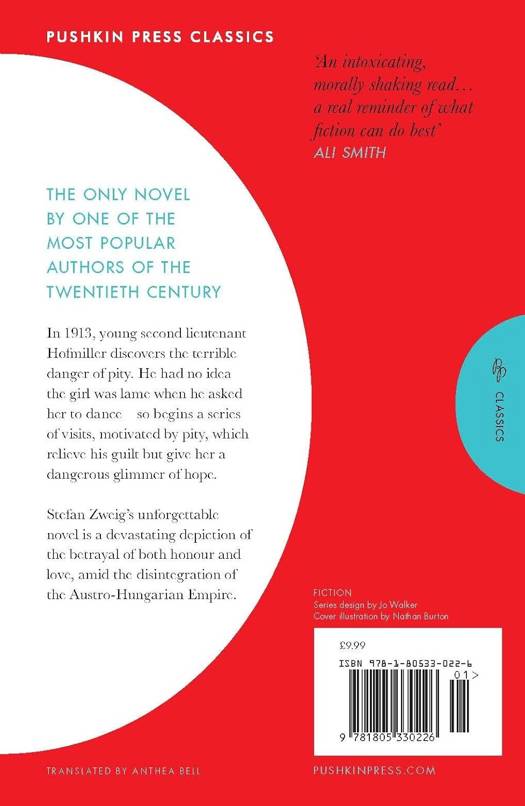
Stefan Zweig's tragic novel of guilt, yearning, and the danger of pity, which inspired Wes Anderson's The Grand Budapest Hotel. "Original and powerful." --The New York Times The only novel Zweig--one of the most popular authors of the 20th century--completed and published during his lifetime, Beware of Pity is a heartrending tale of unequal affection, unintended consequences, and a world falling to pieces. In 1913, young second lieutenant Hofmiller discovers the terrible danger of pity. Stationed at the edge of the Austro-Hungarian Empire, he is invited to a party by a rich local landowner, who also happens to have a pretty daughter. But when Hofmiller asks the girl to dance he unleashes a fatal chain of consequences. He had no idea she was lame, and finds himself in an agony of shamed embarrassment. So begins a series of visits, motivated by pity, which relieves his guilt but gives her a dangerous glimmer of hope. Stefan Zweig's only full-length novel has inspired multiple stage adaptations and was the starting point for Wes Anderson's film The Grand Budapest Hotel. Unfolding in a breathless sweep from Hofmiller's initial mistake, it displays at full length all the psychological insight and emotional intensity known to readers of Zweig's bestselling novellas. A century after it was first written, Beware of Pity remains a devastating depiction of the betrayal of both honour and love, realised against the background of the disintegration of the Austro-Hungarian Empire and the beginnings of the First World War.
Spécifications
Parties prenantes
- Auteur(s) :
- Traducteur(s):
- Editeur:
Contenu
- Nombre de pages :
- 464
- Langue:
- Anglais
- Collection :
Caractéristiques
- EAN:
- 9781805330226
- Date de parution :
- 05-01-27
- Format:
- Livre broché
- Format numérique:
- Trade paperback (VS)
- Dimensions :
- 129 mm x 198 mm
- Poids :
- 367 g



Seulement chez Librairie Club
+ 27 points sur votre carte client de Librairie Club
Cadeau


Les avis
Nous publions uniquement les avis qui respectent les conditions requises. Consultez nos conditions pour les avis.