


- Retrait en 2 heures
- Assortiment impressionnant
- Paiement sécurisé
- Toujours un magasin près de chez vous
- Retrait en 2 heures
- Assortiment impressionnant
- Paiement sécurisé
- Toujours un magasin près de chez vous



41,45 €
+ 82 points
Description
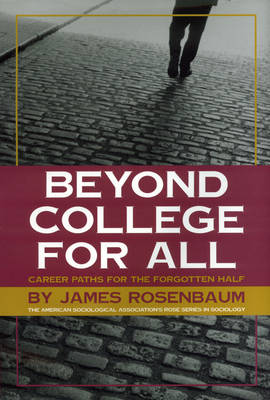
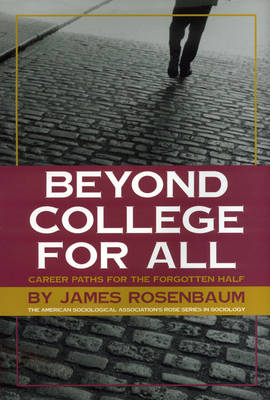
In a society where everyone is supposed to go to college, the problems facing high school graduates who do not continue their education are often forgotten. Many cannot find jobs, and those who do are often stuck in low-wage, dead-end positions. Meanwhile employers complain that high school graduates lack the necessary skills for today's workplace. Beyond College for All focuses on this crisis in the American labor market. Around the world, author James E. Rosenbaum finds, employers view high school graduates as valuable workers. Why not here? Rosenbaum reports on new studies of the interaction between employers and high schools in the United States. He concludes that each fails to communicate its needs to the other, leading to a predictable array of problems for young people in the years after graduation. High schools caught up in the college-for-all myth, provide little job advice or preparation, leading students to make unrealistic plans and hampering both students who do not go to college and those who start college but do not finish. Employers say they care about academic skills, but then do not consider grades when deciding whom to hire. Faced with few incentives to achieve, many students lapse into precisely the kinds of habits employers deplore, doing as little as possible in high school and developing poor attitudes. Rosenbaum contrasts the situation in the United States with that of two other industrialized nations-Japan and Germany-which have formal systems for aiding young people who are looking for employment. Virtually all Japanese high school graduates obtain work, and in Germany, eighteen-year-olds routinely hold responsible jobs. While the American system lacks such formal linkages, Rosenbaum uncovers an encouraging hidden system that helps many high school graduates find work. He shows that some American teachers, particularly vocational teachers, create informal networks with employers to guide students into the labor market. Enterprising employers have figures out how to use these networks to meet their labor needs, while students themselves can take steps to increase their ability to land desirable jobs. Beyond College for All suggests new policies based on such practices. Rosenbaum presents a compelling case that the problems faced by American high school graduates and employers can be solved if young people, employers, and high schools build upon existing informal networks to create formal paths for students to enter the world of work. A Volume in the American Sociological Association's Rose Series in Sociology
Spécifications
Parties prenantes
- Auteur(s) :
- Editeur:
Contenu
- Nombre de pages :
- 335
- Langue:
- Anglais
- Collection :
Caractéristiques
- EAN:
- 9780871547538
- Date de parution :
- 16-12-04
- Format:
- Livre broché
- Format numérique:
- Trade paperback (VS)
- Dimensions :
- 167 mm x 228 mm
- Poids :
- 508 g


Seulement chez Librairie Club
+ 82 points sur votre carte client de Librairie Club
Cadeau


Les avis
Nous publions uniquement les avis qui respectent les conditions requises. Consultez nos conditions pour les avis.