


- Retrait en 2 heures
- Assortiment impressionnant
- Paiement sécurisé
- Toujours un magasin près de chez vous
- Retrait en 2 heures
- Assortiment impressionnant
- Paiement sécurisé
- Toujours un magasin près de chez vous



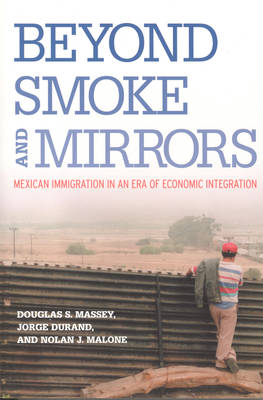
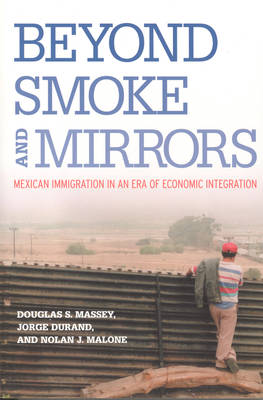
Beyond Smoke and Mirrors
Mexican Immigration in an Era of Economic Integration
Douglas S Massey, Jorge Durand, Nolan J Malone
Livre broché | Anglais
39,95 €
+ 79 points
Description
Migration between Mexico and the United States is part of a historical process of increasing North American integration. This process acquired new momentum with the passage of the North American Free Trade Agreement in 1994, which lowered barriers to the movement of goods, capital, services, and information. But rather than include labor in this new regime, the United States continues to resist the integration of the labor markets of the two countries. Instead of easing restrictions on Mexican labor, the United States has militarized its border and adopted restrictive new policies of immigrant disenfranchisement. Beyond Smoke and Mirrors examines the devastating impact of these immigration policies on the social and economic fabric of the Mexico and the United States, and calls for a sweeping reform of the current system. Beyond Smoke and Mirrors shows how U.S. immigration policies enacted between 1986-1996--largely for symbolic domestic political purposes--harm the interests of Mexico, the United States, and the people who migrate between them. The costs have been high. The book documents how the massive expansion of border enforcement has wasted billions of dollars and hundreds of lives, yet has not deterred increasing numbers of undocumented immigrants from heading north. The authors also show how the new policies unleashed a host of unintended consequences: a shift away from seasonal, circular migration toward permanent settlement; the creation of a black market for Mexican labor; the transformation of Mexican immigration from a regional phenomenon into a broad social movement touching every region of the country; and even the lowering of wages for legal U.S. residents. What had been a relatively open and benign labor process before 1986 was transformed into an exploitative underground system of labor coercion, one that lowered wages and working conditions of undocumented migrants, legal immigrants, and American citizens alike. Beyond Smoke and Mirrors offers specific proposals for repairing the damage. Rather than denying the reality of labor migration, the authors recommend regularizing it and working to manage it so as to promote economic development in Mexico, minimize costs and disruptions for the United States, and maximize benefits for all concerned. This book provides an essential "user's manual" for readers seeking a historical, theoretical, and substantive understanding of how U.S. policy on Mexican immigration evolved to its current dysfunctional state, as well as how it might be fixed.
Spécifications
Parties prenantes
- Auteur(s) :
- Editeur:
Contenu
- Nombre de pages :
- 209
- Langue:
- Anglais
Caractéristiques
- EAN:
- 9780871545909
- Date de parution :
- 11-09-03
- Format:
- Livre broché
- Format numérique:
- Trade paperback (VS)
- Dimensions :
- 174 mm x 229 mm
- Poids :
- 326 g


Seulement chez Librairie Club
+ 79 points sur votre carte client de Librairie Club
Cadeau


Les avis
Nous publions uniquement les avis qui respectent les conditions requises. Consultez nos conditions pour les avis.