


- Retrait en 2 heures
- Assortiment impressionnant
- Paiement sécurisé
- Toujours un magasin près de chez vous
- Retrait gratuit dans votre magasin Club
- 7.000.0000 titres dans notre catalogue
- Payer en toute sécurité
- Toujours un magasin près de chez vous




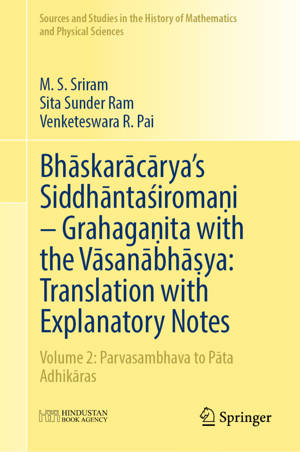
Bhaskaracarya's Siddhantasiromani - Grahaganita with the Vasanabhasya: Translation with Explanatory Notes
Volume 2: Parvasambhava to Pata Adhikaras
M.S. Sriram, Sita Sunder Ram, Venketeswara R. Pai
160,45 €
+ 320 points
Description
The Siddhantasiromani was composed in 1150 CE by the celebrated mathematician astronomer Bhaskaracarya. In the Grahaganitadhyaya part of it, most of the standard calculations and algorithms in Indian astronomy of his times are included. All these are explained in detail with commentary on the text, namely, the Vasanabhasya or Mitaksara. This book is on this part only. All the 460 verses of this part have been translated afresh in this work. Now, it is in the Vasanabhasya that the contents of the verses are expounded in detail. In addition, the detailed derivations and proofs of the statements and algorithms are presented in the upapattis. Study of the vasana is indispensable for understanding the methodology of, in particular, and thereby, of Indian astronomers in general. The distinct scientific method of Bhaskara (indeed of the Indian astronomical tradition in general, of which he was a leading exponent), his approach to problems and the ways to solve them, can be understood only when one goes through the commentary and understands it. It is for this reason that the Vasanabhasya has been translated into English for all the verses, for the first time. Explanatory notes based on the vasana of Bhaskara have been provided for all the verses in modern notation, with a large number of diagrams to facilitate the understanding.
The Grahaganitadhyaya has 12 chapters, which is divided into two volumes: Volume 1: Madhyama, Spas a, Triprasna and Volume 2: Parvasambhava to Pata Adhikaras. Volume 1 has three chapters the Madhyamadhikara, Spas adhikara and the Triprasnadhikara. This volume has a comprehensive introduction and two appendices on the Indian planetary model and elements of spherical trigonometry, which make this book reasonably self-contained. Volume 2 has the nine chapters Parvasambhava, Candragrahana, Suryagrahana, Grahacchaya, Udayasta, Srngonnati, Grahayuti, Bhagrahayuti and the Pata adhikaras.
Spécifications
Parties prenantes
- Auteur(s) :
- Editeur:
Contenu
- Langue:
- Anglais
- Collection :
Caractéristiques
- EAN:
- 9789819592104
- Date de parution :
- 14-05-26
- Format:
- Livre relié
- Dimensions :
- 155 mm x 235 mm


Seulement chez Librairie Club
+ 320 points sur votre carte client de Librairie Club
Cadeau

Cadeau


Les avis
Nous publions uniquement les avis qui respectent les conditions requises. Consultez nos conditions pour les avis.