


- Retrait en 2 heures
- Assortiment impressionnant
- Paiement sécurisé
- Toujours un magasin près de chez vous
- Retrait gratuit dans votre magasin Club
- 7.000.0000 titres dans notre catalogue
- Payer en toute sécurité
- Toujours un magasin près de chez vous



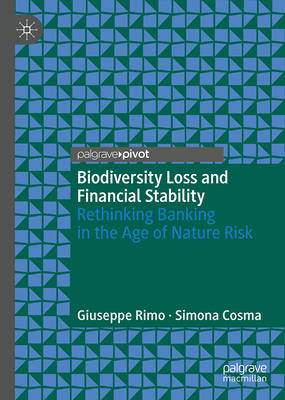
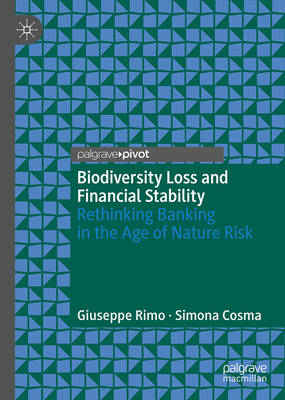
Biodiversity Loss and Financial Stability
Rethinking Banking in the Age of Nature Risk
Giuseppe Rimo, Simona Cosma
42,95 €
+ 85 points
Description
This book analyzes the financial implications of biodiversity loss and the critical role banks play in both amplifying and mitigating this risk. Drawing on recent academic contributions, central bank reports, and empirical insights, the book frames biodiversity loss as both a source of physical and transition risk, and a driver of financial contagion through disrupted supply chains, asset devaluation, and credit defaults in nature-dependent sectors. The volume describes banking exposure to biodiversity-related risk and evaluates existing tools to measure and manage this exposure, including biodiversity-adjusted ESG ratings, Corporate Biodiversity Footprints (CBF), and the TNFD framework. It then turns to the transformative role that banks can play, through conditional lending, biodiversity-linked instruments, and stewardship strategies, in reversing ecological harm and supporting nature-positive transitions. Targeted at scholars, regulators, and financial practitioners, this book provides a novel framework for integrating biodiversity risk into financial decision-making, prudential supervision, and impact finance. It concludes with actionable policy recommendations and an agenda for future research on nature-related financial risks.
Spécifications
Parties prenantes
- Auteur(s) :
- Editeur:
Contenu
- Langue:
- Anglais
- Collection :
Caractéristiques
- EAN:
- 9783032176301
- Date de parution :
- 29-04-26
- Format:
- Livre relié
- Dimensions :
- 148 mm x 210 mm


Seulement chez Librairie Club
+ 85 points sur votre carte client de Librairie Club

Les avis
Nous publions uniquement les avis qui respectent les conditions requises. Consultez nos conditions pour les avis.