


- Retrait en 2 heures
- Assortiment impressionnant
- Paiement sécurisé
- Toujours un magasin près de chez vous
- Retrait en 2 heures
- Assortiment impressionnant
- Paiement sécurisé
- Toujours un magasin près de chez vous



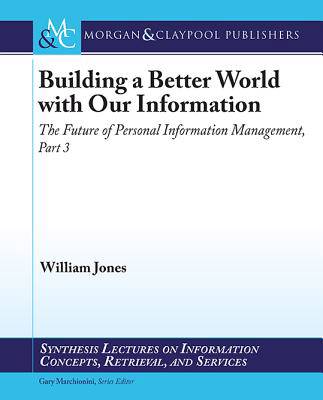
Building a Better World with Our Information
The Future of Personal Information Management, Part 3
William Jones
84,95 €
+ 169 points
Format
Description
Personal Information Management (PIM) is the art of getting things done in our lives through information. How do we - can we better - manage our information at home, at school, at work, at play and "@large" in a global community? How do we use information not only to know but also to represent, communicate and effect useful change in the world around us? In the study of PIM, does the search for practical methods with practical impact lead to methods that are "massive open on-line"? Can the ancient practice of storytelling help us better to weave our fragmented information together? In the practice of PIM, how can our information best serve as "near knowledge" - close at hand and, through our information tools, serving in practical ways to extend the knowledge that's "in the head"? If attempts to multitask lead to ineffective, even dangerous, instances of task switching and divided attention, can better PIM help us to realize, instead, opportunities for "multi-goaling" where the same time and effort accomplishes not just one but several goals? These and other questions are addressed in this third and final book to conclude the series on "The Future of Personal Information Management". Part 1, "Our Information, Always and Forever", covered the fundamentals of PIM and then explored the seismic shift, already well underway, towards a world where our information is always at hand (thanks to our devices) and "forever" on the web. Part 2, "Transforming Technologies to Manage Our Information", provided a more focused look at technologies for managing information. The opening chapter discussed "natural interface" technologies of input/output to free us from keyboard, screen and mouse. Successive chapters then explored technologies to save, search and structure our information. A concluding chapter introduced the possibility that we may see dramatic reductions in the "clerical tax" we pay as we work with our information. Now in Part 3, "Building a Better World with Our Information", focus shifts to the practical present and to the near future. Part 3 is in three chapters: - Group information management and the social fabric in PIM. How do we preserve and promote our PIM practices as we interact with others at home, at work, at play and in wider, even global, communities? (Chapter 10). - Designing for PIM in the development of tools and in the selection of teachable (learnable) "better practices" of PIM. (Chapter 11). - To each of us, our own concludes with an exploration of the ways each of us, individually, can develop better practices for the management of our information in service of the lives we wish to live and towards a better world we all must share. (Chapter 12).
Spécifications
Parties prenantes
- Auteur(s) :
- Editeur:
Contenu
- Nombre de pages :
- 203
- Langue:
- Anglais
- Collection :
Caractéristiques
- EAN:
- 9781627053419
- Date de parution :
- 01-08-15
- Format:
- Livre broché
- Format numérique:
- Trade paperback (VS)
- Dimensions :
- 190 mm x 235 mm
- Poids :
- 358 g


Seulement chez Librairie Club
+ 169 points sur votre carte client de Librairie Club
Cadeau


Les avis
Nous publions uniquement les avis qui respectent les conditions requises. Consultez nos conditions pour les avis.