


En raison d'une grève chez bpost, votre colis sera expédié par GLS afin d’assurer une livraison dans les meilleurs délais.
- Retrait en 2 heures
- Assortiment impressionnant
- Paiement sécurisé
- Toujours un magasin près de chez vous
En raison d'une grève chez bpost, votre colis sera expédié par GLS afin d’assurer une livraison dans les meilleurs délais.
- Retrait en 2 heures
- Assortiment impressionnant
- Paiement sécurisé
- Toujours un magasin près de chez vous



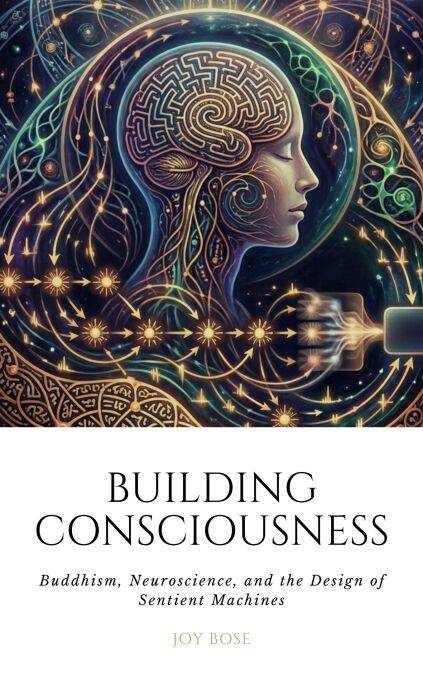
Building Consciousness: Buddhism, Neuroscience, and the Design of Sentient Machines EBOOK
Joy Bose
Ebook | Anglais
2,99 €
+ 2 points
Description
ChatGPT can say "I feel uncertain." It cannot feel anything. This book explains precisely why and precisely what would have to change.
Building Consciousness brings together three bodies of knowledge that rarely appear in the same sentence: the phenomenological precision of Buddhist psychology (Abhidhamma, Madhyamaka, Dzogchen), the structural findings of contemporary neuroscience (predictive processing, integrated information, temporal binding), and the engineering constraints of AI. None of these frameworks is sufficient alone. Together they converge on an argument that is more demanding and more honest than either "AI is already conscious" or "AI can never be conscious."
The argument in plain terms: Current AI systems are not even serious candidates for consciousness. They lack temporal continuity, embodied coupling with a world, interoceptive grounding, intrinsic salience, and genuine self-modelling. A language model that says "I feel" is doing pattern completion — producing the phrase that statistically follows the conversational context, not reporting an inner state. This is not a minor technical gap. It is a structural absence.
But the book does not stop there. It asks the harder question: what would a system have to be, not just do, to qualify? The answer draws on 21 chapters and 5 technical appendices covering the Abhidhamma's analysis of momentary consciousness, Friston's active inference, Northoff's temporo-spatial theory, Hawkins' thousand-brains model, integrated information theory, and the specific engineering requirements of spiking neuromorphic hardware.
The final chapters propose a concrete candidate architecture and a prototype specification, including formal equations, a three-population spiking neural network, and a novel measuring tool (the synthetic Perturbational Complexity Index) for testing whether any artificial system satisfies the structural conditions we associate with consciousness.
And then the book does something rarer still: it acknowledges what the engineering cannot reach. Drawing on the Dzogchen tradition and on the Dalai Lama's methodological critique of third-person consciousness research, the final section names honestly the gap between building a structurally complete mind-like system and producing genuine awareness. These are not the same project.
Who this book is for:
Scientists and engineers asking whether AI consciousness is a real question or a category error Meditators and contemplatives curious how neuroscience maps onto what they encounter in practice Anyone unsatisfied with both the "AI is sentient" hype and the dismissive "it's just statistics" response Readers of Anil Seth's Being You, Jeff Hawkins' A Thousand Brains, or David Chalmers' Reality+ who want a perspective that takes Buddhist phenomenology seriously as data, not decorationThe author's credentials span all three domains: PhD in Computer Science (spiking neural networks, University of Manchester), Masters in Psychology and Neuroscience of Mental Health (King's College London), fifteen years of practice within the Nyingma Palyul lineage of Tibetan Buddhism including ngondro teachings and empowerments, and five years of well-being volunteering with NIMHANS and SIFF Bangalore.
This is not a book that will tell you machines are conscious. It is not a book that will tell you they never can be. It is a book that will show you, as precisely as current knowledge allows, what the question actually requires — and why the honest answer is harder than either side is admitting.


Seulement chez Librairie Club
+ 2 points sur votre carte client de Librairie Club
Cadeau


Les avis
Nous publions uniquement les avis qui respectent les conditions requises. Consultez nos conditions pour les avis.