


- Retrait en 2 heures
- Assortiment impressionnant
- Paiement sécurisé
- Toujours un magasin près de chez vous
- Retrait en 2 heures
- Assortiment impressionnant
- Paiement sécurisé
- Toujours un magasin près de chez vous



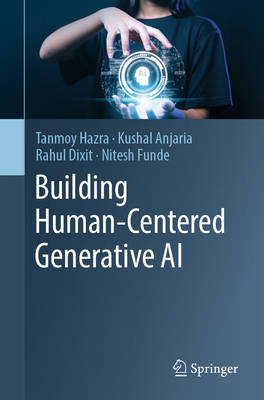
Building Human-Centered Generative AI
Tanmoy Hazra, Kushal Anjaria, Rahul Dixit, Nitesh Funde
Livre broché | Anglais
54,45 €
+ 108 points
Description
This book addresses critical ethical, social, and technological challenges that arise from the rapid integration of Generative AI systems into diverse aspects of human life. The shift toward human-centered GAI emerges as a response to increasing concerns about AI's embedded biases, opacity, and potential misalignment with human values. By centering on human experiences, agency, and ethical principles, this paradigm fosters the development of GAI that is explainable, interpretable, trustworthy, and aligned with societal needs.
Building Human-Centered Generative AI offers a comprehensive roadmap for rethinking generative AI as a technology that serves people first, not metrics or scale. Bringing together principles from computer science, human-computer interaction, ethics, psychology, and design, it shows how empathy, fairness, transparency, and accountability can be systematically embedded into models, interfaces, and deployment lifecycles. Rather than treating ethics as an afterthought, the book positions human values, user needs, and social impact as core design requirements for any serious generative AI initiative.
Written for graduate students, researchers, practitioners, and policymakers, this book functions both as a scholarly reference and as a practical playbook for responsible innovation. It equips teams with actionable methods for participatory and value-sensitive design, human-in-the-loop collaboration, GenAIOps governance, and multidimensional evaluation focused on trust, usability, and societal impact. For anyone tasked with designing, deploying, or regulating generative AI, Building Human-Centered Generative AI provides the conceptual grounding and hands-on guidance needed to align powerful new technologies with human dignity, equity, and long-term social good.
Spécifications
Parties prenantes
- Auteur(s) :
- Editeur:
Contenu
- Nombre de pages :
- 143
- Langue:
- Anglais
Caractéristiques
- EAN:
- 9783032214119
- Date de parution :
- 27-05-26
- Format:
- Livre broché
- Format numérique:
- Trade paperback (VS)
- Dimensions :
- 155 mm x 235 mm


Seulement chez Librairie Club
+ 108 points sur votre carte client de Librairie Club
Cadeau


Les avis
Nous publions uniquement les avis qui respectent les conditions requises. Consultez nos conditions pour les avis.