


- Retrait en 2 heures
- Assortiment impressionnant
- Paiement sécurisé
- Toujours un magasin près de chez vous
- Retrait en 2 heures
- Assortiment impressionnant
- Paiement sécurisé
- Toujours un magasin près de chez vous



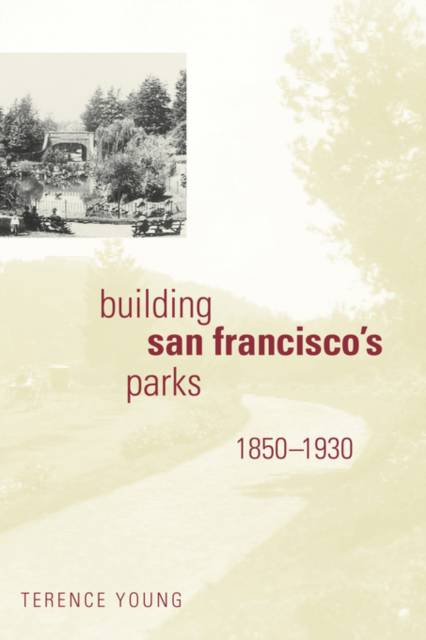
Building San Francisco's Parks, 1850-1930
Terence Young
56,45 €
+ 112 points
Description
In 1865, when San Francisco's Daily Evening Bulletin asked its readers if it were not time for the city to finally establish a public park, residents had only private gardens and small urban squares where they could retreat from urban crowding, noise, and filth. Five short years later, city supervisors approved the creation of Golden Gate Park, the second largest urban park in America. Over the next sixty years, and particularly after 1900, a network of smaller parks and parkways was built, turning San Francisco into one of the nation's greenest cities. In Building San Francisco's Parks, 1850-1930, Terence Young traces the history of San Francisco's park system, from the earliest city plans, which made no provision for a public park, through the private garden movement of the 1850s and 1860, Frederick Law Olmsted's early involvement in developing a comprehensive parks plan, the design and construction of Golden Gate Park, and finally to the expansion of green space in the first third of the twentieth century. Young documents this history in terms of the four social ideals that guided America's urban park advocates and planners in this period: public health, prosperity, social coherence, and democratic equality. He also differentiates between two periods in the history of American park building, each defined by a distinctive attitude towards "improving" nature: the romantic approach, which prevailed from the 1860s to the 1880s, emphasized the beauty of nature, while the rationalistic approach, dominant from the 1880s to the 1920s, saw nature as the best setting for uplifting activities such as athletics and education. Building San Francisco's Parks, 1850-1930 maps the political, cultural, and social dimensions of landscape design in urban America and offers new insights into the transformation of San Francisco's physical environment and quality of life through its world-famous park system.
Spécifications
Parties prenantes
- Auteur(s) :
- Editeur:
Contenu
- Nombre de pages :
- 280
- Langue:
- Anglais
- Collection :
Caractéristiques
- EAN:
- 9780801889813
- Date de parution :
- 01-04-08
- Format:
- Livre broché
- Format numérique:
- Trade paperback (VS)
- Dimensions :
- 152 mm x 229 mm
- Poids :
- 412 g


Seulement chez Librairie Club
+ 112 points sur votre carte client de Librairie Club
Cadeau


Les avis
Nous publions uniquement les avis qui respectent les conditions requises. Consultez nos conditions pour les avis.