


- Retrait en 2 heures
- Assortiment impressionnant
- Paiement sécurisé
- Toujours un magasin près de chez vous
- Retrait en 2 heures
- Assortiment impressionnant
- Paiement sécurisé
- Toujours un magasin près de chez vous



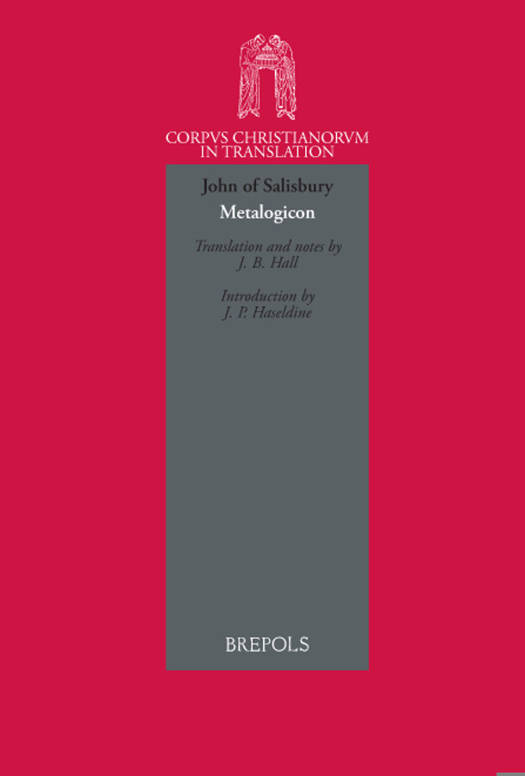
CCT 12 Metalogicon, John of Salisbury, Hall
Jb Hall
68,90 €
+ 137 points
Description
John of Salisbury has long been celebrated as one of the foremost humanists of the twelfth-century renaissance, an erudite correspondent, legal expert, historian, poet, diplomat and political thinker, and clerk to two successive archbishops of Canterbury, Theobald and Thomas Becket.His Metalogicon, ostensibly a defence of the role of logic and of Aristotle's Organon in the educational syllabus of the day, makes a powerful argument for an educational system of real practical utility for society, one whose intellectual coherence and rigour should underpin political morality and rational governance. As such, it has been seen to stand alongside the more famous Policraticus as an integral part of the intellectual contribution of one of Europe's great political theorists. Based on John's own experiences as a student and a teacher, the treatise offers unique evidence of the educational system of twelfth-century Paris at a critical stage in the early development of the schools, and of the earliest reception of the Aristotelian texts of the 'new logic'. It is also an important contribution to the tradition of pedagogical and educational thought, with its unique attention to teaching methods and its belief in the purpose of education both for the formation of the person and for the good of society. The treatise has been accorded an important place in many modern scholarly debates, including those on the origins of the universities, on medieval philosophy and on medieval humanism. This new translation is based on the edition of J.B. Hall, auxiliata K.S.B. Keats-Rohan, which appeared in Corpus Christianorum Continuatio Mediaeualis as Iohannes Saresberiensis - Metalogicon (CCCM 98), and so makes available to the student and general reader for the first time a translation of a text of this important work established on modern critical principles. References to the corresponding pages of the Corpus Christianorum edition are provided in the margins of this translation. Professor J.B. Hall is Hildred Carlile Professor of Latin Emeritus, University of London.Apart from John of Salisbury, he has published books on the textual criticism of Claudian, Ovid and Statius. Dr Julian P. Haseldine is Senior Lecturer in Medieval History at the University of Hull.He has edited the letters of Peter of Celle and published widely on medieval friendship and friendship networks.
Spécifications
Parties prenantes
- Auteur(s) :
- Editeur:
Contenu
- Nombre de pages :
- 369
- Langue:
- Anglais
- Collection :
- Tome:
- n° 12
Caractéristiques
- EAN:
- 9782503533988
- Date de parution :
- 15-05-13
- Format:
- Livre broché
- Format numérique:
- Trade paperback (VS)
- Dimensions :
- 157 mm x 234 mm
- Poids :
- 612 g


Seulement chez Librairie Club
+ 137 points sur votre carte client de Librairie Club
Cadeau


Les avis
Nous publions uniquement les avis qui respectent les conditions requises. Consultez nos conditions pour les avis.