


- Retrait en 2 heures
- Assortiment impressionnant
- Paiement sécurisé
- Toujours un magasin près de chez vous
- Retrait en 2 heures
- Assortiment impressionnant
- Paiement sécurisé
- Toujours un magasin près de chez vous



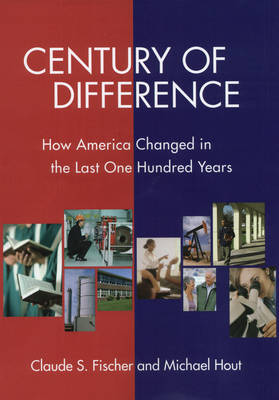
Century of Difference
How America Changed in the Last One Hundred Years
Claude S Fischer, Michael Hout
Livre broché | Anglais
59,45 €
+ 118 points
Description
In every generation, Americans have worried about the solidarity of the nation. Since the days of the Mayflower, those already settled here have wondered how newcomers with different cultures, values, and (frequently) skin color would influence America. Would the new groups create polarization and disharmony? Thus far, the United States has a remarkable track record of incorporating new people into American society, but acceptance and assimilation have never meant equality. In Century of Difference, Claude Fischer and Michael Hout provide a compelling--and often surprising--new take on the divisions and commonalities among the American public over the tumultuous course of the twentieth century. Using a hundred years worth of census and opinion poll data, Century of Difference shows how the social, cultural, and economic fault lines in American life shifted in the last century. It demonstrates how distinctions that once loomed large later dissipated, only to be replaced by new ones. Fischer and Hout find that differences among groups by education, age, and income expanded, while those by gender, region, national origin, and, even in some ways, race narrowed. As the twentieth century opened, a person's national origin was of paramount importance, with hostilities running high against Africans, Chinese, and southern and eastern Europeans. Today, diverse ancestries are celebrated with parades. More important than ancestry for today's Americans is their level of schooling. Americans with advanced degrees are increasingly putting distance between themselves and the rest of society--in both a literal and a figurative sense. Differences in educational attainment are tied to expanding inequalities in earnings, job quality, and neighborhoods. Still, there is much that ties all Americans together. Century of Difference knocks down myths about a growing culture war. Using seventy years of survey data, Fischer and Hout show that Americans did not become more fragmented over values in the late-twentieth century, but rather were united over shared ideals of self-reliance, family, and even religion. As public debate has flared up over such matters as immigration restrictions, the role of government in redistributing resources to the poor, and the role of religion in public life, it is important to take stock of the divisions and linkages that have typified the U.S. population over time. Century of Difference lucidly profiles the evolution of American social and cultural differences over the last century, examining the shifting importance of education, marital status, race, ancestry, gender, and other factors on the lives of Americans past and present. A Volume in the Russell Sage Foundation Census Series
Spécifications
Parties prenantes
- Auteur(s) :
- Editeur:
Contenu
- Nombre de pages :
- 421
- Langue:
- Anglais
Caractéristiques
- EAN:
- 9780871543684
- Date de parution :
- 16-10-08
- Format:
- Livre broché
- Format numérique:
- Trade paperback (VS)
- Dimensions :
- 155 mm x 232 mm
- Poids :
- 625 g


Seulement chez Librairie Club
+ 118 points sur votre carte client de Librairie Club
Cadeau


Les avis
Nous publions uniquement les avis qui respectent les conditions requises. Consultez nos conditions pour les avis.