


- Retrait en 2 heures
- Assortiment impressionnant
- Paiement sécurisé
- Toujours un magasin près de chez vous
- Retrait gratuit dans votre magasin Club
- 7.000.0000 titres dans notre catalogue
- Payer en toute sécurité
- Toujours un magasin près de chez vous



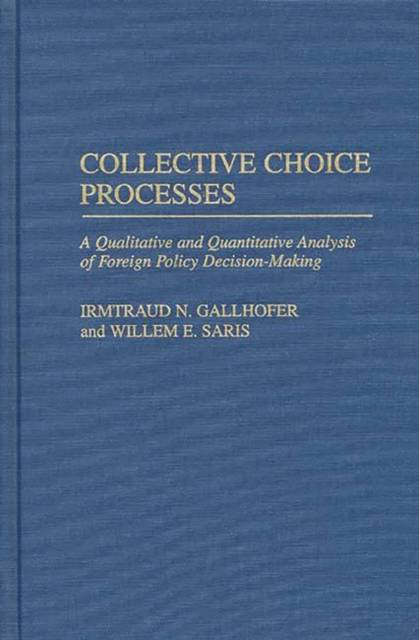
Collective Choice Processes
A Qualitative and Quantitative Analysis of Foreign Policy Decision-Making
Irmtraud N Gallhofer, Willem E Saris
Livre relié | Anglais
169,95 €
+ 339 points
Description
Gallhofer and Saris examine the collective choice processes in different decision-making units leading to World Wars I and II as well as the Cuban Missile Crisis, colonial wars, and to major foreign policy decisions of a European government after World War II. In the unit relating to the European government, they find strong evidence for consensual decision-making. But when disagreements occurred among the participants, alternative procedures were employed, such as postponements in order to search for additional information, shifts from argumentation to find a compromise, and change from consensus to majority decision-making. How quickly these shifts were made depended on the group norms.
This book provides a theoretical framework to understand how different foreign-policy decision-making units or groups arrive at a collective choice. The qualitative and quantitative studies presented here are based on written records and deal with the choice process of four different decision-making units in situations that pertain to important foreign policy decisions. Germany's decision-making process under Hitler to initiate World War II exemplifies a group with a leader who is insensitive to advice, making the decisions himself and using the group only for acclamation. Kennedy's decision-making during the Cuban Missile Crisis is very different, as it shows a leader sensitive to advice where the group has the task of presenting different options and their consequences. The Austro-Hungarian cabinet's decision to initiate World War I exemplifies a homogeneous group with a dissenter, although it arrived at a collective decision quite quickly using persuasion, compromise, and some coercion. The bulk of the study deals with a heterogeneous unit in a great variety of decision situations, because most Western European governments are of this type. Where there is extreme conflict and time pressure, consensual decision-making is abandoned and a majority choice is hammered out. As the first systematic documented study of collective decision-making, as it pertains to different decision units, this book will be of considerable importance to scholars and researchers investigating the decision-making process in government and international affairs.Spécifications
Parties prenantes
- Auteur(s) :
- Editeur:
Contenu
- Nombre de pages :
- 224
- Langue:
- Anglais
Caractéristiques
- EAN:
- 9780275960292
- Date de parution :
- 20-11-97
- Format:
- Livre relié
- Format numérique:
- Ongenaaid / garenloos gebonden
- Dimensions :
- 152 mm x 229 mm
- Poids :
- 498 g


Seulement chez Librairie Club
+ 339 points sur votre carte client de Librairie Club
Cadeau

Cadeau


Les avis
Nous publions uniquement les avis qui respectent les conditions requises. Consultez nos conditions pour les avis.