


- Retrait en 2 heures
- Assortiment impressionnant
- Paiement sécurisé
- Toujours un magasin près de chez vous
- Retrait en 2 heures
- Assortiment impressionnant
- Paiement sécurisé
- Toujours un magasin près de chez vous



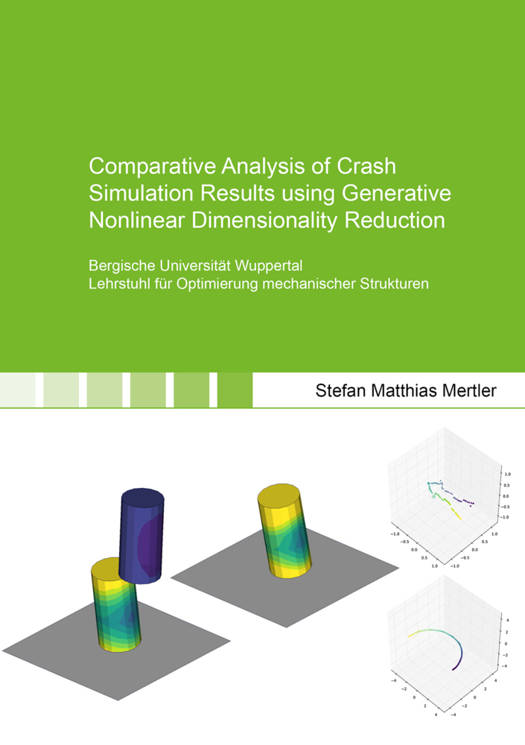
Comparative Analysis of Crash Simulation Results using Generative Nonlinear Dimensionality Reduction
Stefan Matthias Mertler
48,45 €
+ 96 points
Description
Numerical simulations are an integral part of today's product development. Analysing and comparing multiple simulation results is a time consuming but necessary part. Thus, it is important to develop methods to help with this Comparative Analysis by identifying differences in the results. Here it is crucial to determine how such variations relate to each other.So-called Dimensionality Reduction Methods (DRMs) have been used for this since several years. Recently, the need for nonlinear reduction approaches was shown. One widely used method called Difference Principal Component Analysis (DPCA), which computes correlation between different parts of simulations, is based on a linear reduction approach. The aim of this dissertation is to extend the DPCA with nonlinear Dimensionality Reduction (DR).For this, the two steps of the DPCA's workflow were modified. For the first step of DR, several methods of generative DRMs have been extended. For the second so-called subtraction step, the new generalised concept of Difference Dimensionality Reduction was introduced and demonstrated with two specific implementations.The new methods were tested on multiple examples: Firstly, on artificial data to test the individual steps in an isolated environment and secondly on simulation results to evaluate them on realistic data. In the case of a nonlinear relation between these data sets, the superiority over linear approaches was demonstrated, while other linear dependencies were confirmed.With these modifications, the DPCA's workflow is meaningfully applicable to data sets with nonlinear dependencies, and the evaluation suggests a broad range of possible applications, as nonlinearities can occur in many data sets, for example data from topology optimisation or parameter variation.
Spécifications
Parties prenantes
- Auteur(s) :
- Editeur:
Contenu
- Langue:
- Allemand
- Collection :
Caractéristiques
- EAN:
- 9783844087611
- Format:
- Livre broché
- Dimensions :
- 150 mm x 13 mm
- Poids :
- 276 g


Seulement chez Librairie Club
+ 96 points sur votre carte client de Librairie Club
Cadeau


Les avis
Nous publions uniquement les avis qui respectent les conditions requises. Consultez nos conditions pour les avis.