


- Retrait en 2 heures
- Assortiment impressionnant
- Paiement sécurisé
- Toujours un magasin près de chez vous
- Retrait en 2 heures
- Assortiment impressionnant
- Paiement sécurisé
- Toujours un magasin près de chez vous



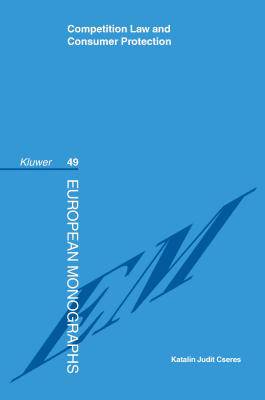
Competition Law and Consumer Protection
Katalin Judit Cseres
149,14 €
+ 298 points
Description
The assumption that competition law and consumer protection are mutually reinforcing is rarely challenged. The theory seems uncontroversial. However, because a positive interaction between the two is presumed to be self-evident, the frequent conflicts that do in fact arise are often dealt with on an ad hoc basis, with no overarching legal authority. There is a clear need for a detailed and coherent understanding of exactly where the complements and tensions between the two policy areas exist. Dr Cseres in-depth analysis provides that understanding. Proceeding from the dual perspective of law and economics that is, of justice, fairness, and reasonableness on the one hand, and of efficiency of the other she fully considers such underlying issues as the following: the role of competition law and consumer law in a free market economy; the notion of consumer welfare; the effect of the modernisation of EC competition law for consumers; economics theories of information, bounded rationality, and transaction costs; the special significance of vertical agreements and merger control; and, how consumers are affected by information asymmetries. The ultimate focus of the book is on current and emerging EC law, in which a rapprochement between the two areas seems to be under way. Dr. Cseres provides a knowledgeable guide to the various strands of theory, policy, and jurisprudence that (she shows) ought to be taken into account in the process, including schools of thought and law and policy experience in both Europe and the United States. A special chapter on Hungary, where post-1989 law and practice reveal a fresh and distinctly forward-looking understanding of the matter, is one of the book's most extraordinary features. Competition Law and Consumer Protection stands alone as a committed contribution to bridging a gap in legal knowledge the significance of which grows daily. It will be of immeasurable value to a wide range of professionals from academics and researchers to officials, policymakers, and practitioners in competition law, consumer protection advocacy, economic theory and planning, business administration, and various pertinent government authorities.
Spécifications
Parties prenantes
- Auteur(s) :
- Editeur:
Contenu
- Nombre de pages :
- 464
- Langue:
- Anglais
- Collection :
Caractéristiques
- EAN:
- 9789041123800
- Date de parution :
- 01-06-05
- Format:
- Livre relié
- Format numérique:
- Genaaid
- Dimensions :
- 168 mm x 246 mm
- Poids :
- 898 g


Seulement chez Librairie Club
+ 298 points sur votre carte client de Librairie Club
Cadeau


Les avis
Nous publions uniquement les avis qui respectent les conditions requises. Consultez nos conditions pour les avis.