


- Retrait en 2 heures
- Assortiment impressionnant
- Paiement sécurisé
- Toujours un magasin près de chez vous
- Retrait en 2 heures
- Assortiment impressionnant
- Paiement sécurisé
- Toujours un magasin près de chez vous



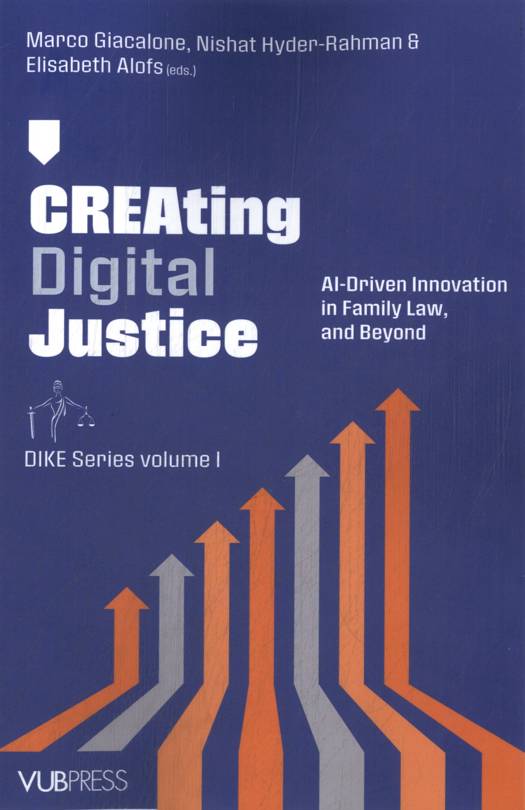
Creating Digital Justice: AI-Driven Innovation in Family Law, and Beyond
Elisabeth Alofs
Livre broché | Anglais
45,00 €
+ 90 points
Description
Artificial intelligence is reshaping the conceptual and institutional foundations of justice, altering how legal systems articulate, administer, and embody fairness. CREAting Digital Justice: AI-Driven Innovation in Family Law, and Beyond brings together leading scholars and practitioners to critically engage with this transformation through the prism of one of law’s most complex and value-laden fields: family justice.
Situated within the research framework of CREA – Conflict Resolution with Equitative Algorithms, the volume investigates how technology is transforming the law, legal practice, access to justice and, by extension, society as a whole. Family law emerges here as a revealing site for examining the broader implications of automation, human oversight, and equity in the evolving landscape of digital justice.
Contributors engage with the promise and peril of digital justice – from predictive tools and online mediation to the governance of smart legal environments – offering grounded analyses of their normative and institutional implications. Moving beyond technocratic optimism or resistance, the collection proposes a vision of equitative digital justice anchored in transparency, accountability, and respect for human dignity.
Balancing theoretical insight with empirical observation, CREAting Digital Justice invites jurists, policymakers, and technologists to reflect on what it means to design justice in an algorithmic age and how to do so responsibly.
The editorial committee is composed of Prof. Dr. Marco Giacalone, Prof. Dr. Elisabeth Alofs, and Dr. Nishat Hyder-Rahman. They are members of the Research Group on Digitalisation and Access to Justice (DIKE), the Brussels Research Institute on Development, Governance and Empowerment through Law (BRIDGE), and the Department of Private and Economic Law (PREC) of the Vrije Universiteit Brussel.
This book was made possible through funding from the European Union (under the CREA2 Project, Grant Agreement No. 101046629).
Situated within the research framework of CREA – Conflict Resolution with Equitative Algorithms, the volume investigates how technology is transforming the law, legal practice, access to justice and, by extension, society as a whole. Family law emerges here as a revealing site for examining the broader implications of automation, human oversight, and equity in the evolving landscape of digital justice.
Contributors engage with the promise and peril of digital justice – from predictive tools and online mediation to the governance of smart legal environments – offering grounded analyses of their normative and institutional implications. Moving beyond technocratic optimism or resistance, the collection proposes a vision of equitative digital justice anchored in transparency, accountability, and respect for human dignity.
Balancing theoretical insight with empirical observation, CREAting Digital Justice invites jurists, policymakers, and technologists to reflect on what it means to design justice in an algorithmic age and how to do so responsibly.
The editorial committee is composed of Prof. Dr. Marco Giacalone, Prof. Dr. Elisabeth Alofs, and Dr. Nishat Hyder-Rahman. They are members of the Research Group on Digitalisation and Access to Justice (DIKE), the Brussels Research Institute on Development, Governance and Empowerment through Law (BRIDGE), and the Department of Private and Economic Law (PREC) of the Vrije Universiteit Brussel.
This book was made possible through funding from the European Union (under the CREA2 Project, Grant Agreement No. 101046629).
Spécifications
Parties prenantes
- Auteur(s) :
- Editeur:
Contenu
- Nombre de pages :
- 160
- Langue:
- Anglais
Caractéristiques
- EAN:
- 9789493491137
- Date de parution :
- 17-12-25
- Format:
- Livre broché
- Dimensions :
- 161 mm x 241 mm
- Poids :
- 330 g



Seulement chez Librairie Club
+ 90 points sur votre carte client de Librairie Club
Cadeau


Les avis
Nous publions uniquement les avis qui respectent les conditions requises. Consultez nos conditions pour les avis.