


- Retrait en 2 heures
- Assortiment impressionnant
- Paiement sécurisé
- Toujours un magasin près de chez vous
- Retrait en 2 heures
- Assortiment impressionnant
- Paiement sécurisé
- Toujours un magasin près de chez vous



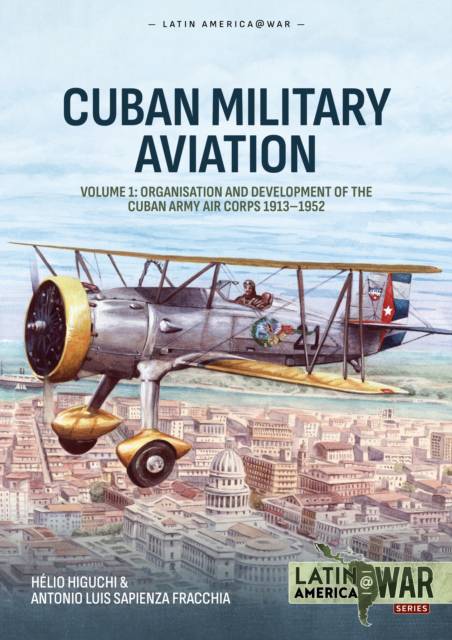
Cuban Military Aviation Volume 1
Organisation and Development of the Cuban Army Air Corps 1913-1952
Hélio Higuchi, Antonio Luis Sapienza Fracchia
27,95 €
+ 55 points
Description
"...very well researched and quite image intensive." - ModelingMadness.Com
Cuban Military Aviation Volume 1: Organisation and Development of the Cuban Army Air Corps, 1913-1952 presents the first comprehensive English-language study of the origins and evolution of military aviation in Cuba. Drawing on rare photographs, extensive archival research, and original artwork, this volume traces the creation, structure, and operations of the Cuerpo de Aviación del Ejército de Cuba (CAEC) from its founding in 1913 through to its transformation into the Fuerza Aérea del Ejército de Cuba in 1952.
Cuba was a pioneer in Latin American military aviation. Just over a decade after gaining independence from Spain, the nation had already established an air arm--well before many of its regional peers. Early Cuban aviators trained in the United States during the First World War, and a Cuban air squadron was nearly dispatched to the Western Front before the Armistice intervened. In the interwar years, the CAEC gradually expanded its aircraft inventory and institutional capabilities, including goodwill flights across Central America and the Caribbean, and active involvement in internal conflicts such as the Gibara Expedition.
Cuban military aviation came of age during the Second World War. Though not a frontline combatant, Cuba supported the Allied cause and benefitted from the US Lend-Lease programme, acquiring modern aircraft such as the AT-6 Texan and B-25 Mitchell, and receiving American training for its pilots and mechanics. In the post-war period, further aid followed through initiatives such as the American Republics Program (ARP) and the Mutual Defense Assistance Program (MDAP), which helped the CAEC maintain and modernise its forces.
This volume explores the development of aviation infrastructure, training institutions, and operational doctrine within the CAEC. It also covers key episodes such as the Cayo Confites expedition, the establishment of Cuban Naval Aviation in the 1930s, and the acquisition of increasingly capable aircraft for reconnaissance, transport, and combat roles during the 1940s and early 1950s. The book additionally offers a concise biographical portrait of Fulgencio Batista, whose political influence shaped much of Cuba's military policy during this period.
A detailed appendix lists all aircraft types operated by the CAEC and Naval Aviation between 1913 and 1952, and the volume is extensively illustrated with period photographs and specially commissioned full-colour profiles that bring the story of Cuban aviation to life.
This is the first in a two-part series, with a companion volume examining the transition from the CAEC to the Cuban Air Force and its subsequent transformation in the revolutionary period. Cuban Military Aviation Volume 1 is an essential resource for scholars, aviation historians, and readers interested in Latin American military development in the 20th century.
Cuban Military Aviation Volume 1: Organisation and Development of the Cuban Army Air Corps, 1913-1952 presents the first comprehensive English-language study of the origins and evolution of military aviation in Cuba. Drawing on rare photographs, extensive archival research, and original artwork, this volume traces the creation, structure, and operations of the Cuerpo de Aviación del Ejército de Cuba (CAEC) from its founding in 1913 through to its transformation into the Fuerza Aérea del Ejército de Cuba in 1952.
Cuba was a pioneer in Latin American military aviation. Just over a decade after gaining independence from Spain, the nation had already established an air arm--well before many of its regional peers. Early Cuban aviators trained in the United States during the First World War, and a Cuban air squadron was nearly dispatched to the Western Front before the Armistice intervened. In the interwar years, the CAEC gradually expanded its aircraft inventory and institutional capabilities, including goodwill flights across Central America and the Caribbean, and active involvement in internal conflicts such as the Gibara Expedition.
Cuban military aviation came of age during the Second World War. Though not a frontline combatant, Cuba supported the Allied cause and benefitted from the US Lend-Lease programme, acquiring modern aircraft such as the AT-6 Texan and B-25 Mitchell, and receiving American training for its pilots and mechanics. In the post-war period, further aid followed through initiatives such as the American Republics Program (ARP) and the Mutual Defense Assistance Program (MDAP), which helped the CAEC maintain and modernise its forces.
This volume explores the development of aviation infrastructure, training institutions, and operational doctrine within the CAEC. It also covers key episodes such as the Cayo Confites expedition, the establishment of Cuban Naval Aviation in the 1930s, and the acquisition of increasingly capable aircraft for reconnaissance, transport, and combat roles during the 1940s and early 1950s. The book additionally offers a concise biographical portrait of Fulgencio Batista, whose political influence shaped much of Cuba's military policy during this period.
A detailed appendix lists all aircraft types operated by the CAEC and Naval Aviation between 1913 and 1952, and the volume is extensively illustrated with period photographs and specially commissioned full-colour profiles that bring the story of Cuban aviation to life.
This is the first in a two-part series, with a companion volume examining the transition from the CAEC to the Cuban Air Force and its subsequent transformation in the revolutionary period. Cuban Military Aviation Volume 1 is an essential resource for scholars, aviation historians, and readers interested in Latin American military development in the 20th century.
Spécifications
Parties prenantes
- Auteur(s) :
- Editeur:
Contenu
- Nombre de pages :
- 86
- Langue:
- Anglais
- Collection :
Caractéristiques
- EAN:
- 9781804517178
- Date de parution :
- 31-08-25
- Format:
- Livre broché
- Format numérique:
- Trade paperback (VS)
- Dimensions :
- 206 mm x 296 mm
- Poids :
- 340 g


Seulement chez Librairie Club
+ 55 points sur votre carte client de Librairie Club
Cadeau


Les avis
Nous publions uniquement les avis qui respectent les conditions requises. Consultez nos conditions pour les avis.