


- Retrait en 2 heures
- Assortiment impressionnant
- Paiement sécurisé
- Toujours un magasin près de chez vous
- Retrait en 2 heures
- Assortiment impressionnant
- Paiement sécurisé
- Toujours un magasin près de chez vous



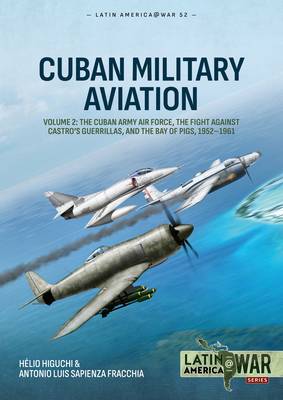
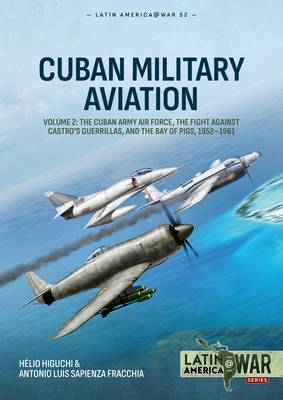
Cuban Military Aviation Volume 2
The Cuban Army Air Force, the Fight Against Castro's Guerrillas, and the Bay of Pigs, 1952-1961
Hélio Higuchi, Antonio Luis Sapienza Fracchia
27,95 €
+ 55 points
Description
Cuban Military Aviation Volume 2: The Cuban Army Air Force, the fight against Castro's Guerrillas, and the Bay of Pigs, 1952-1961 continues the definitive two-part study of Cuba's air power, examining the turbulent decade that saw the island's military aviation thrust into sustained combat, political collapse, and Cold War confrontation.
Following the reorganisation of the Cuerpo de Aviación del Ejército de Cuba into the Fuerza Aérea del Ejército de Cuba (FAEC) in 1952, Cuban air power expanded rapidly in response to the growing insurgency led by Fidel Castro's Movimiento 26 de Julio. Drawing on extensive archival research, rare photographs, and first-hand accounts, this volume traces how the FAEC evolved from a conventional air arm into a force heavily engaged in counterinsurgency operations, flying thousands of combat sorties against guerrilla forces in the Sierra Maestra and across the island.
The book provides a detailed operational analysis of air campaigns conducted with aircraft such as the F-47 Thunderbolt, B-26 Invader, T-33 Shooting Star, and a wide array of light liaison and attack aircraft. It examines the introduction of helicopters, forward air control techniques, night operations, and the growing strains placed on personnel and matériel by an intensifying civil war, compounded by political interference, corruption, and the imposition of a US arms embargo.
With the collapse of the Batista regime in January 1959, Cuban military aviation underwent a dramatic transformation. The FAEC was dissolved and replaced by the Fuerza Aérea Revolucionaria (FAR), inheriting much of its predecessor's equipment but stripped of experienced aircrew through purges, trials, imprisonment, and exile. This volume charts the chaotic reconstitution of the air force under revolutionary rule, the reliance on civilian pilots and foreign volunteers, and the difficult transition toward Soviet alignment.
The final chapters offer a comprehensive account of the air war during the Bay of Pigs invasion in April 1961, analysing the decisive aerial engagements between the FAR and the exile Fuerza Aérea de Liberación, flown largely with aircraft inherited from the pre-revolutionary era. These operations marked the last combat use of many Second World War-era aircraft in Cuban service and directly shaped Havana's rapid turn to Soviet air power.
Extensively illustrated with period photographs, colour profiles, maps, and detailed aircraft tables, Cuban Military Aviation Volume 2 provides the most thorough English language examination to date of Cuban air operations during revolution and regime change. Together with Volume 1, it forms an essential reference for aviation historians, military scholars, and readers interested in Latin American conflicts and early Cold War air warfare.
Following the reorganisation of the Cuerpo de Aviación del Ejército de Cuba into the Fuerza Aérea del Ejército de Cuba (FAEC) in 1952, Cuban air power expanded rapidly in response to the growing insurgency led by Fidel Castro's Movimiento 26 de Julio. Drawing on extensive archival research, rare photographs, and first-hand accounts, this volume traces how the FAEC evolved from a conventional air arm into a force heavily engaged in counterinsurgency operations, flying thousands of combat sorties against guerrilla forces in the Sierra Maestra and across the island.
The book provides a detailed operational analysis of air campaigns conducted with aircraft such as the F-47 Thunderbolt, B-26 Invader, T-33 Shooting Star, and a wide array of light liaison and attack aircraft. It examines the introduction of helicopters, forward air control techniques, night operations, and the growing strains placed on personnel and matériel by an intensifying civil war, compounded by political interference, corruption, and the imposition of a US arms embargo.
With the collapse of the Batista regime in January 1959, Cuban military aviation underwent a dramatic transformation. The FAEC was dissolved and replaced by the Fuerza Aérea Revolucionaria (FAR), inheriting much of its predecessor's equipment but stripped of experienced aircrew through purges, trials, imprisonment, and exile. This volume charts the chaotic reconstitution of the air force under revolutionary rule, the reliance on civilian pilots and foreign volunteers, and the difficult transition toward Soviet alignment.
The final chapters offer a comprehensive account of the air war during the Bay of Pigs invasion in April 1961, analysing the decisive aerial engagements between the FAR and the exile Fuerza Aérea de Liberación, flown largely with aircraft inherited from the pre-revolutionary era. These operations marked the last combat use of many Second World War-era aircraft in Cuban service and directly shaped Havana's rapid turn to Soviet air power.
Extensively illustrated with period photographs, colour profiles, maps, and detailed aircraft tables, Cuban Military Aviation Volume 2 provides the most thorough English language examination to date of Cuban air operations during revolution and regime change. Together with Volume 1, it forms an essential reference for aviation historians, military scholars, and readers interested in Latin American conflicts and early Cold War air warfare.
Spécifications
Parties prenantes
- Auteur(s) :
- Editeur:
Contenu
- Nombre de pages :
- 100
- Langue:
- Anglais
- Collection :
Caractéristiques
- EAN:
- 9781806720378
- Date de parution :
- 31-03-26
- Format:
- Livre broché
- Format numérique:
- Trade paperback (VS)
- Dimensions :
- 206 mm x 298 mm
- Poids :
- 385 g


Seulement chez Librairie Club
+ 55 points sur votre carte client de Librairie Club
Cadeau


Les avis
Nous publions uniquement les avis qui respectent les conditions requises. Consultez nos conditions pour les avis.