


- Retrait en 2 heures
- Assortiment impressionnant
- Paiement sécurisé
- Toujours un magasin près de chez vous
- Retrait en 2 heures
- Assortiment impressionnant
- Paiement sécurisé
- Toujours un magasin près de chez vous



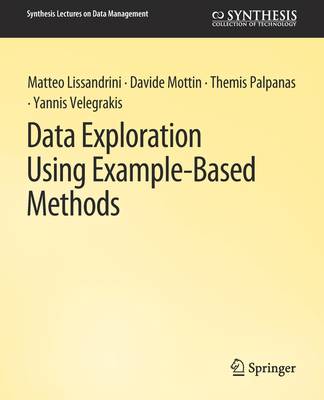
Data Exploration Using Example-Based Methods
Matteo Lissandrini, Davide Mottin, Themis Palpanas, Yannis Velegrakis
54,45 €
+ 108 points
Format
Description
Data usually comes in a plethora of formats and dimensions, rendering the exploration and information extraction processes challenging. Thus, being able to perform exploratory analyses in the data with the intent of having an immediate glimpse on some of the data properties is becoming crucial. Exploratory analyses should be simple enough to avoid complicate declarative languages (such as SQL) and mechanisms, and at the same time retain the flexibility and expressiveness of such languages. Recently, we have witnessed a rediscovery of the so-called example-based methods, in which the user, or the analyst, circumvents query languages by using examples as input. An example is a representative of the intended results, or in other words, an item from the result set. Example-based methods exploit inherent characteristics of the data to infer the results that the user has in mind, but may not able to (easily) express. They can be useful in cases where a user is looking for information in an unfamiliar dataset, when the task is particularly challenging like finding duplicate items, or simply when they are exploring the data. In this book, we present an excursus over the main methods for exploratory analysis, with a particular focus on example-based methods. We show how that different data types require different techniques, and present algorithms that are specifically designed for relational, textual, and graph data. The book presents also the challenges and the new frontiers of machine learning in online settings which recently attracted the attention of the database community. The lecture concludes with a vision for further research and applications in this area.
Spécifications
Parties prenantes
- Auteur(s) :
- Editeur:
Contenu
- Nombre de pages :
- 146
- Langue:
- Anglais
- Collection :
Caractéristiques
- EAN:
- 9783031007385
- Date de parution :
- 27-11-18
- Format:
- Livre broché
- Format numérique:
- Trade paperback (VS)
- Dimensions :
- 190 mm x 235 mm
- Poids :
- 294 g


Seulement chez Librairie Club
+ 108 points sur votre carte client de Librairie Club
Cadeau


Les avis
Nous publions uniquement les avis qui respectent les conditions requises. Consultez nos conditions pour les avis.