


- Retrait en 2 heures
- Assortiment impressionnant
- Paiement sécurisé
- Toujours un magasin près de chez vous
- Retrait gratuit dans votre magasin Club
- 7.000.0000 titres dans notre catalogue
- Payer en toute sécurité
- Toujours un magasin près de chez vous




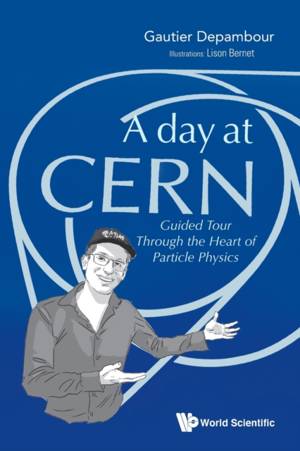
Day at Cern, A: Guided Tour Through the Heart of Particle Physics
Gautier Depambour
Livre broché | Anglais
43,45 €
+ 86 points
Description
'This brief book offers an interesting, fun, and widely accessible first-person tour of CERN, the European Center for Nuclear Research, the largest particle physics laboratory in the world. The facilities at CERN include the Large Hadron Collider (LHC), a 27-kilometer particle accelerator that straddles the border between Switzerland and France. The LHC was famously used to discover the Higgs boson, a long-sought fundamental particle. Physics historian Depambour (University of Paris) is enthusiastic about all aspects of CERN, especially its role as an agent for peace and international cooperation. The book focuses mainly on the physical layout of the CERN campus and its experimental facilities, but Depambour also includes an introduction to the standard model of particle physics and a history of the search for the Higgs boson. Supporting illustrations and interviews help convey the atmosphere and culture of CERN. The book can be read and enjoyed by virtually anyone interested in modern science, starting with students currently in high school. It will also be welcome as a useful orientation for undergraduates and graduate students whose research interests might eventually take them to CERN. Summing Up: Highly recommended. All readers.'CHOICEWhat lies within CERN's entrails? What is the path followed by the particles that are accelerated before they collide? What does the ATLAS detector look like? Does research at CERN find applications in everyday life?From the accelerator control room to the huge Computing Centre, via the auditorium where the discovery of the Higgs boson was announced in July 2012, I invite you to experience for one day an immersion in the world of research in particle physics! Discovering emblematic installations at CERN, walking through the places where people spend every working day, meeting with researchers in various fields, descending into the ATLAS cavern ... Our visit, whose path will mimic that of the particles during their journey, will be full of anecdotes and surprises.Follow me for a guided tour of CERN, the largest scientific collaboration in the world!
Spécifications
Parties prenantes
- Auteur(s) :
- Editeur:
Contenu
- Nombre de pages :
- 164
- Langue:
- Anglais
Caractéristiques
- EAN:
- 9789811220647
- Date de parution :
- 26-08-20
- Format:
- Livre broché
- Format numérique:
- Trade paperback (VS)
- Dimensions :
- 152 mm x 229 mm
- Poids :
- 226 g


Seulement chez Librairie Club
+ 86 points sur votre carte client de Librairie Club

Les avis
Nous publions uniquement les avis qui respectent les conditions requises. Consultez nos conditions pour les avis.