


- Retrait en 2 heures
- Assortiment impressionnant
- Paiement sécurisé
- Toujours un magasin près de chez vous
- Retrait en 2 heures
- Assortiment impressionnant
- Paiement sécurisé
- Toujours un magasin près de chez vous



33,95 €
+ 67 points
Description
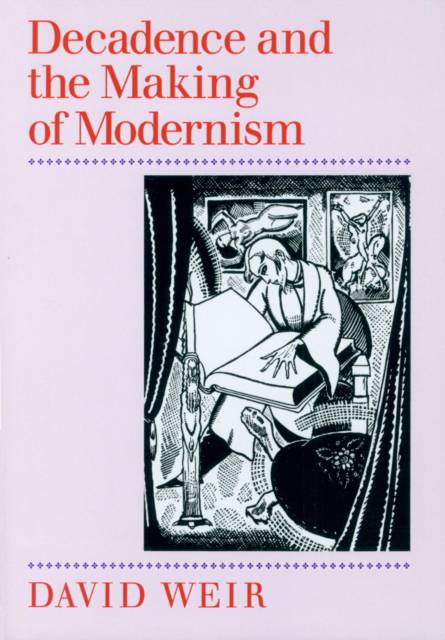
The cultural phenomenon known as "decadence" has often been viewed as an ephemeral artistic vogue that flourished briefly in late nineteenth- and early twentieth-century Europe. This study makes the case for decadence as a literary movement in its own right, based on a set of aesthetic principles that formed a transitional link between romanticism and modernism.
Understand in this developmental context, decadence represents the aesthetic substratum of a wide range of fin-de-siècle literary schools, including naturalism, realism, Parnassianism, aestheticism, and symbolism. As an impulse toward modernism, it prefigures the thematic, structural, and stylistic concerns of later literature.
David Weir demonstrates his thesis by analyzing a number of French, English, Italian, and American novels, each associated with some specific decadent literary tendency. For example, he uses Flaubert's Salammbô, the brothers Goncourts' Germinie Lacerteux, and Walter Pater's Marius the Epicurean to explore the affiliations between decadence romanticism, naturalism, and aestheticism, respectively. This approach allows Weir to clarify the multiple meanings of decadence and to challenge certain longstanding misconceptions, such as the notion of decadence as a mannered and inferior form of high culture.
The book concludes by arguing that the decadent sensibility persists in popular culture and contemporary theory, with multiculturalism and postmodernism representing its most current manifestations.
Spécifications
Parties prenantes
- Auteur(s) :
- Editeur:
Contenu
- Nombre de pages :
- 272
- Langue:
- Anglais
Caractéristiques
- EAN:
- 9780870239922
- Date de parution :
- 05-01-96
- Format:
- Livre broché
- Format numérique:
- Trade paperback (VS)
- Dimensions :
- 166 mm x 234 mm
- Poids :
- 453 g



Seulement chez Librairie Club
+ 67 points sur votre carte client de Librairie Club
Cadeau


Les avis
Nous publions uniquement les avis qui respectent les conditions requises. Consultez nos conditions pour les avis.