


- Retrait en 2 heures
- Assortiment impressionnant
- Paiement sécurisé
- Toujours un magasin près de chez vous
- Retrait gratuit dans votre magasin Club
- 7.000.0000 titres dans notre catalogue
- Payer en toute sécurité
- Toujours un magasin près de chez vous



Description
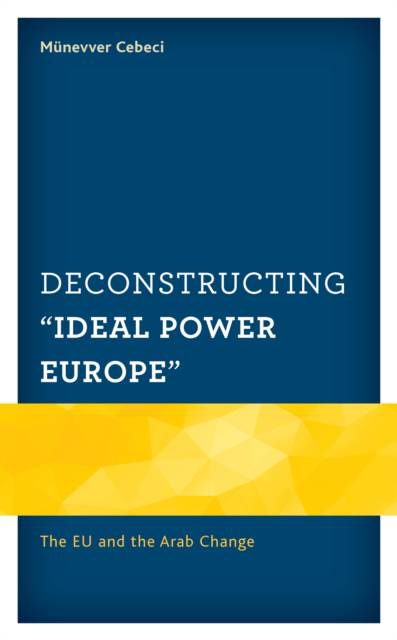
Deconstructing "Ideal Power Europe" The EU and Arab Change criticizes the dominant discourse on European foreign policy, which represents the EU as a force for good in world politics. Using a poststructuralist approach, it deconstructs the EU's representation as "an ideal power" through an analysis of European foreign policy on the Southern Mediterranean before and after the Arab uprisings. In this endeavor, it displaces three major discourses which construct the EU as "ideal" the "postmodern and post-sovereign EU", "the EU as a model/a virtuous example", and, "the EU as a normative power" discourses. The major argument of the book is that the "ideal power Europe" meta-narrative is especially produced and reproduced in the EU's approach towards the Southern Mediterranean, and, it manifests itself through the rhetoric of "responsibility" and "universality" in the aftermath of the Arab uprisings. The book also provides an analysis of how the "ideal power Europe" meta-narrative feeds into and legitimizes European governmentality in the world, in general, and, in the case of the Southern Mediterranean after the Arab uprisings, in particular. Arguing that the depiction of the EU as postmodern/post-sovereign, as a model/an exemplar, and as a normative power pertains to the representation of a "regulatory ideal", it elucidates how the EU pursues hegemonic practices in the Southern Mediterranean. It further manifests how the EU's governmentality is marked by a securitized, depoliticizing, and technocratic approach which feeds into and gets legitimized by the dominant discourse on European foreign policy; reproducing the EU's "ideal" identity vis-à-vis its "imperfect" Arab other.
Spécifications
Parties prenantes
- Auteur(s) :
- Editeur:
Contenu
- Nombre de pages :
- 156
- Langue:
- Anglais
- Collection :
Caractéristiques
- EAN:
- 9781498539036
- Date de parution :
- 31-12-18
- Format:
- Livre relié
- Format numérique:
- Genaaid
- Dimensions :
- 152 mm x 229 mm
- Poids :
- 399 g


Seulement chez Librairie Club
+ 390 points sur votre carte client de Librairie Club
Cadeau

Cadeau


Les avis
Nous publions uniquement les avis qui respectent les conditions requises. Consultez nos conditions pour les avis.