


- Retrait en 2 heures
- Assortiment impressionnant
- Paiement sécurisé
- Toujours un magasin près de chez vous
- Retrait en 2 heures
- Assortiment impressionnant
- Paiement sécurisé
- Toujours un magasin près de chez vous



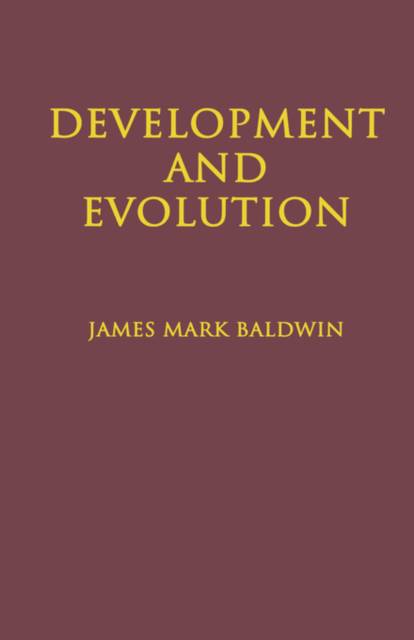
Development and Evolution
Including Psychophysical, Evolution, Evolution by Orthoplasy, and the Theory of Genetic Modes
James Mark Baldwin
Livre relié | Anglais
98,95 €
+ 197 points
Description
James Mark Baldwin (1861-1934) was one of American psychology's greatest contributors, both professionally and intellectually. Professionally, he founded experimental laboratories at the Universities of Toronto and Princeton, established two important journals: The Psychological Review and The Psychological Bulletin, and served as President of the American Psychological Association. Intellectually, Baldwin was one of the field's most prolific authors and quite possibly its most sophisticated thinker. Over the course of his career, he published twenty-two books and approximately one-hundred-fifty articles. Among his publications were the field's first well-controlled experimental studies of infant behavior and a work, Social and Ethical Interpretations in Mental Development. Between 1901 and 1905 he edited a three volume Dictionary of Philosophy and Psychology that is still one of the best sources for turn-of-the-century thought in these disciplines. This led directly to his receiving Oxford University's first honorary doctorate of science. Baldwin's biosocial approach introduced a level of complexity in conceptualization of the mind, its evolutionary origins, ontogenetic development, and sociocultural formation that went far beyond the prevailing thought of the period. He addressed topics as varied as the nature of developmental and evolutionary mechanisms, the relationship between reason and reality, the genesis of logic, the value of aesthetic experience, and the nature and development in children of habit, imitation, creative invention, altruism, egoism, morality, social suggestibility, social self, self-awareness, theory of mind, and enculturation. His use and in some cases introduction of concepts such as multiplicity of self, ideal self, self-esteem, assimilation, accommodation, primary circular reaction, genetic logic, genetic epistemology, and social heredity exerted a formative influence on later scholars such as George Herbert Mead, Jean Piaget, Lev S. Vygotsky, and Lawrence Kohlberg. In Development and Evolution, Baldwin had arrived at a clear conception of the mechanism mediating the influence of individual adaptations on the course of phylogenetic evolution. As he described it in an autobiographical chapter written toward the end of his life, the theory of organic selection involved the claim that: "natural selection operating on "spontaneous variations" is sufficient alone to produce determinate evolution (without the inheritance of acquired adaptations or modifications), since - and this is the new point - in each generation variations in the direction of, or "coincident" with, the function to be developed will favor the organisms possessing them, and their descendants will profit by the accumulation of such variations. Thus the function will gradually come to perfection. In other words, the individual organism's accommodations, made through learning, effort, adaptation, etc., while not physically inherited, still act to supplement or screen the congenital endowment during its incomplete stages, and so give the species time to build up its variations in determinate lines." This title is increasingly heavily cited because of the great interest in how development is represented genetically and how changes in gene expression during development, especially regulatory genes, occur through selection on phenotypes
Spécifications
Parties prenantes
- Auteur(s) :
- Editeur:
Contenu
- Nombre de pages :
- 416
- Langue:
- Anglais
Caractéristiques
- EAN:
- 9781930665132
- Date de parution :
- 01-06-04
- Format:
- Livre relié
- Format numérique:
- Genaaid
- Dimensions :
- 140 mm x 216 mm
- Poids :
- 675 g


Seulement chez Librairie Club
+ 197 points sur votre carte client de Librairie Club
Cadeau


Les avis
Nous publions uniquement les avis qui respectent les conditions requises. Consultez nos conditions pour les avis.