

- Retrait en 2 heures
- Assortiment impressionnant
- Paiement sécurisé
- Toujours un magasin près de chez vous
- Retrait gratuit dans votre magasin Club
- 7.000.0000 titres dans notre catalogue
- Payer en toute sécurité
- Toujours un magasin près de chez vous



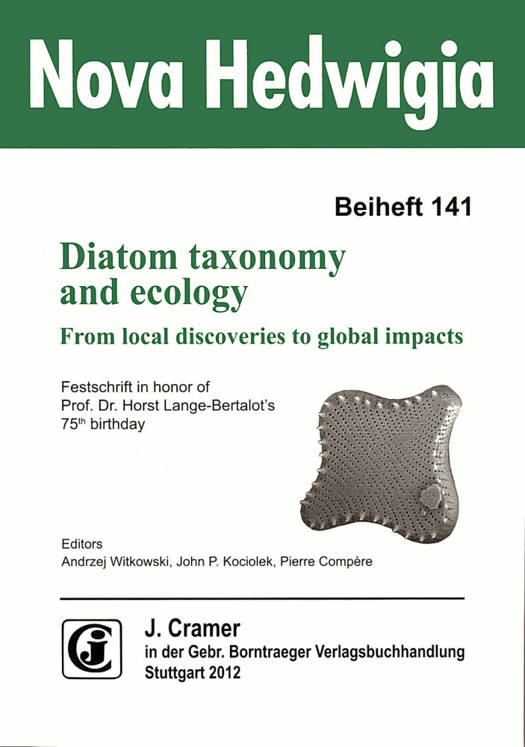
Diatom taxonomy and ecology From local discoveries to global impacts
Festschrift in honor of Prof.Dr. Horst Lange-Bertalot's 75th birthday
196,45 €
+ 392 points
Description
The twenty-nine peer-reviewed contributions to this impressive volume sweep the entire range of current research on diatoms - from the taxonomy of freshwater and marine diatoms, the fossil record of both terrestrial and marine habitats, planktonic diatoms, potential of diatoms and ostracods as bioindicators, application of diatom assemblages to climatic reconstructions, the use of molecular tools in phylogeny, tracing the threat of invasive and potentially toxic diatoms to the highlights of the diatom collection of Józef Pantocsek. The wide range of topics covered herein delineates the equally wide range of research interests of Prof. Horst Lange-Bertalot. The papers were contributed by friends and colleagues on the occasion of his 75th birthday which was celebrated during the 5th Central European Diatomologists Meeting (=25th German-speaking Diatomologists Meeting) in Szczecin, Poland, in February 2011. Many of the authors have benefited from Prof. Lange-Bertalot´s profound knowledge of diatoms in general, and his floristic skills in particular. The impact of his work on diatom research has been extraordinary, with important implications for ecology (from water pollution to climate change), biodiversity and conservation sciences. This has been due in large part to the breadth and depth of Prof. Lange-Bertalots research record in four areas: evaluation of water quality using diatoms, floristics with a focus on Europe, floristics with a worldwide perspective, and synthetic work to organize and integrate these other studies. This tremendous volume honors Professor Horst Lange-Bertalot, one of the pre-eminent diatom taxonomists. This volume is of great interest for all researchers working on diatoms and their impact on biodiversity, conservation sciences and ecology in general.
Spécifications
Parties prenantes
- Editeur:
Contenu
- Nombre de pages :
- 545
- Langue:
- Anglais
- Collection :
- Tome:
- n° 141
Caractéristiques
- EAN:
- 9783443510633
- Format:
- Livre broché
- Dimensions :
- 170 mm x 240 mm
- Poids :
- 1080 g

Seulement chez Librairie Club
+ 392 points sur votre carte client de Librairie Club
Cadeau

Cadeau


Les avis
Nous publions uniquement les avis qui respectent les conditions requises. Consultez nos conditions pour les avis.