


- Retrait en 2 heures
- Assortiment impressionnant
- Paiement sécurisé
- Toujours un magasin près de chez vous
- Retrait en 2 heures
- Assortiment impressionnant
- Paiement sécurisé
- Toujours un magasin près de chez vous



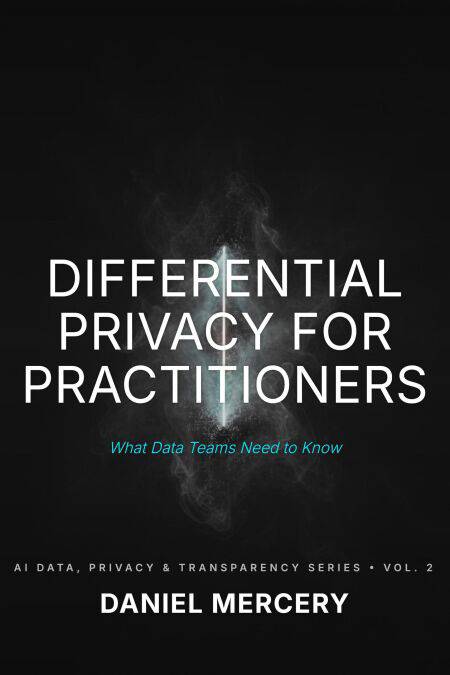
Differential Privacy for Practitioners EBOOK
AI Data, Privacy & Transparency Series, #2
Daniel Mercery
4,49 €
+ 4 points
Description
As data teams are asked to extract more value from sensitive datasets, traditional anonymization techniques are proving insufficient to meet modern privacy and regulatory expectations. Differential privacy has emerged as a mathematically grounded approach, but its practical application remains poorly understood outside academic contexts.
Differential Privacy for Practitioners is a technical, hands-on guide for data engineers and machine learning professionals responsible for building privacy-aware analytics and models. The book explains differential privacy concepts in clear operational terms, focusing on how they are implemented in real systems rather than theoretical proofs.
This volume emphasizes practical decision-making: how to select appropriate privacy parameters, manage cumulative privacy loss, and evaluate the tradeoffs between data utility and privacy guarantees. It is designed to support production use cases, not experimentation alone.
Key areas covered include:
Core concepts and threat models behind differential privacy Understanding epsilon, delta, and privacy budgets Applying differential privacy in analytics and ML pipelines Practical use of common differential privacy libraries Measuring utility loss and model performance impacts Governance and documentation considerations for regulated dataWritten for practitioners operating under real delivery constraints, this book equips data teams to implement differential privacy responsibly while maintaining analytical value and regulatory defensibility.
Spécifications
Parties prenantes
- Auteur(s) :
- Editeur:
Contenu
- Langue:
- Anglais
- Collection :
Caractéristiques
- EAN:
- 9798233395277
- Date de parution :
- 07-01-26
- Format:
- Ebook
- Protection digitale:
- /
- Format numérique:
- ePub



Seulement chez Librairie Club
+ 4 points sur votre carte client de Librairie Club
Cadeau


Les avis
Nous publions uniquement les avis qui respectent les conditions requises. Consultez nos conditions pour les avis.