


- Retrait en 2 heures
- Assortiment impressionnant
- Paiement sécurisé
- Toujours un magasin près de chez vous
- Retrait gratuit dans votre magasin Club
- 7.000.0000 titres dans notre catalogue
- Payer en toute sécurité
- Toujours un magasin près de chez vous



Description
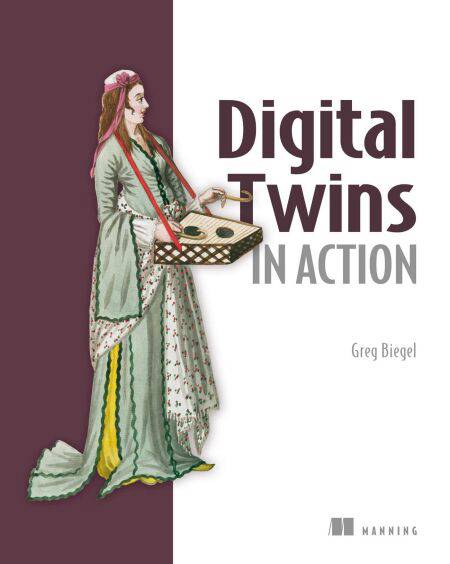
A digital twin is a software-based replica of a physical system that can be used to operate, monitor, and maintain it remotely. Working together, IoT sensors, 3D visualizations, simulation algorithms, AI models, and even robotics give a digital twin an impressive degree of control. This virtual environment is perfect for testing ideas, exploring "what if" scenarios, and unlocking insights—all without making costly changes in reality.
Author Greg Biegel has developed numerous industry-scale digital twin platforms from the ground up. In this book, he shares this unique experience with real-world insights about state of the art digital twins you can put into action today. There’s no niche academic theory—just a complete, practical introduction to every layer of the digital twin stack.
Digital Twins in Action teaches you how to:
• Define clear business objectives for digital twins
• Create digital representations of physical systems
• Blend computer vision, OCR, and generative AI with 3D geometric models
• Stream IoT sensor data into a twin
• Represent real-world systems as knowledge graphs
• Machine learning and agentic AI for analysis and decision-making
About the book
Digital Twins in Action is a hands-on guide to designing and building effective digital twins. In it, you’ll build a home-scale digital twin from the ground up. You’ll start with a framework for gathering requirements to ensure that what you deliver is perfectly suited to your needs. You’ll then work through the complete project step by step—from setting up sensors, to handling hardware, to working with embedded software. By the time you’re finished, you’ll have a twin that can generate 3D models from your phone, extract insights from video and text with computer vision, and even employ an AI agent. Along the way, Greg will point out techniques you can use to scale up your small twin too.
About the reader
For software developers and machine learning engineers. Some knowledge of physical systems engineering is helpful but not required.
About the author
Greg Biegel has been building digital representations of physical systems for large organizations for over 20 years, including 6 years creating a state of the art industrial digital twin platform for a leading Australian energy producer. He holds Computer Science degrees from Rhodes University, South Africa and Trinity College, Dublin.
Author Greg Biegel has developed numerous industry-scale digital twin platforms from the ground up. In this book, he shares this unique experience with real-world insights about state of the art digital twins you can put into action today. There’s no niche academic theory—just a complete, practical introduction to every layer of the digital twin stack.
Digital Twins in Action teaches you how to:
• Define clear business objectives for digital twins
• Create digital representations of physical systems
• Blend computer vision, OCR, and generative AI with 3D geometric models
• Stream IoT sensor data into a twin
• Represent real-world systems as knowledge graphs
• Machine learning and agentic AI for analysis and decision-making
About the book
Digital Twins in Action is a hands-on guide to designing and building effective digital twins. In it, you’ll build a home-scale digital twin from the ground up. You’ll start with a framework for gathering requirements to ensure that what you deliver is perfectly suited to your needs. You’ll then work through the complete project step by step—from setting up sensors, to handling hardware, to working with embedded software. By the time you’re finished, you’ll have a twin that can generate 3D models from your phone, extract insights from video and text with computer vision, and even employ an AI agent. Along the way, Greg will point out techniques you can use to scale up your small twin too.
About the reader
For software developers and machine learning engineers. Some knowledge of physical systems engineering is helpful but not required.
About the author
Greg Biegel has been building digital representations of physical systems for large organizations for over 20 years, including 6 years creating a state of the art industrial digital twin platform for a leading Australian energy producer. He holds Computer Science degrees from Rhodes University, South Africa and Trinity College, Dublin.
Spécifications
Parties prenantes
- Auteur(s) :
- Editeur:
Contenu
- Nombre de pages :
- 325
- Langue:
- Anglais
- Collection :
Caractéristiques
- EAN:
- 9781638358213
- Date de parution :
- 27-07-26
- Format:
- Ebook
- Protection digitale:
- Adobe DRM
- Format numérique:
- ePub



Seulement chez Librairie Club
+ 57 points sur votre carte client de Librairie Club

Les avis
Nous publions uniquement les avis qui respectent les conditions requises. Consultez nos conditions pour les avis.