


- Retrait en 2 heures
- Assortiment impressionnant
- Paiement sécurisé
- Toujours un magasin près de chez vous
- Retrait en 2 heures
- Assortiment impressionnant
- Paiement sécurisé
- Toujours un magasin près de chez vous



6,99 €
+ 6 points
Format
Description
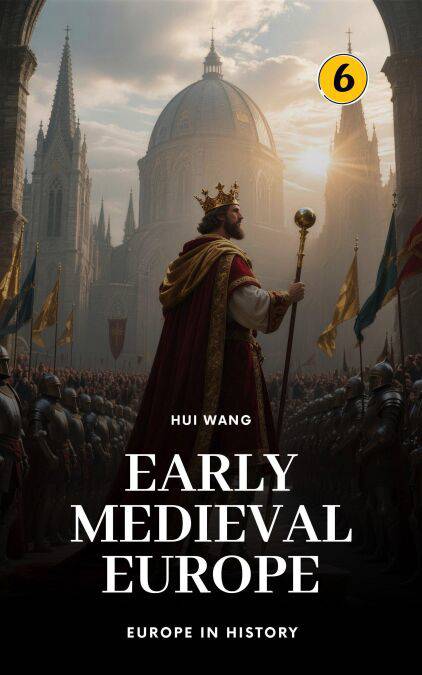
Early Medieval Europe: Europe in History, PART TWO, opens amid the wreckage left by Rome's collapse, where figures such as Galla Placidia, Clovis, and Pope Gregory the Great tried to stitch a shattered world back together when the old rules no longer held. I begin in post‑Roman Italy, a place where barbarian kings—many of them Arian Christians—argued theology as fiercely as they contested territory, where Roman institutions refused to die quietly, and where debates about the Trinity were anything but abstract: doctrinal lines often doubled as political weapons. In that age, survival depended as much on belief and allegiance as on armies and fortresses.
As the narrative moves west and north, it follows the rise of the Franks—from Clovis and the Merovingians, through a period in which royal authority and local power were in constant tension—to a scene of everyday power struggles that reveal how fragile loyalty could be and how kingship had to be reinvented from the ground up. The decisive turn comes with Pepin the Short, who secured papal support, won recognition and anointing, and enacted the Donation of Pepin that helped realign secular and ecclesiastical power across Europe. And then Charlemagne: on maps his empire looked solid and vast, but in practice it rested on personal bonds, military prestige, and contested loyalties, and felt painfully unstable even at its height.
Empire did not end with Charlemagne's coronation—it became a burden. Under Louis the Pious and then Charles the Bald, dynastic quarrels, noble ambition, and the blunt force of Viking raids gradually unraveled Carolingian authority. These chapters follow that slow undoing: kings remained kings in name, but power increasingly depended on negotiation, compromise, and a perpetual scramble to contain crises. Europe, in learning how hard unity could be, discovered that it was expensive and often fleeting.
The book does not stop at Latin Christendom. It moves east and south to trace the rise and transformation of the Islamic caliphates—from Muʿawiya ibn Abi Sufyan and the Umayyads to Harun al-Rashid and al-Ma'mun of the Abbasids. In Baghdad's famed House of Wisdom (Bayt al-Hikma), translation, science, and philosophy flourished at a pace that made Europe's fragmentation look like a different kind of history. Placing these worlds side by side makes it unmistakably clear that early medieval history was shared, interconnected, and far more global than it first appears.
The final chapters turn east, following the rise of the Slavs and the mission of Saints Cyril and Methodius — the ninth‑century Byzantine brothers who brought Christianity to many Slavic peoples and created the first Slavic script, Glagolitic (their disciples later developed what we now call the Cyrillic alphabet). They trace, too, the emergence of Rus under the Varangian leader Rurik, the semi‑legendary figure traditionally said to have been invited to rule Novgorod in 862.
The book closes where history often feels most intimate: with Galla Placidia, daughter of Theodosius I, a woman whose life was bent between empire, invasion, and faith — taken into the turmoil of the early fifth century, entwined with Gothic and Roman courts, and ultimately a central figure in the troubled politics of the late Western Empire.
I wrote this book to show that early medieval Europe was not a dark pause between great eras but the crucible when new political orders, religions, and identities were forged — messy, human, and full of consequences that still shape the world today.
Spécifications
Parties prenantes
- Auteur(s) :
- Editeur:
Contenu
- Langue:
- Anglais
- Collection :
Caractéristiques
- EAN:
- 9789190150221
- Date de parution :
- 10-02-26
- Format:
- Ebook
- Protection digitale:
- /
- Format numérique:
- ePub



Seulement chez Librairie Club
+ 6 points sur votre carte client de Librairie Club
Cadeau


Les avis
Nous publions uniquement les avis qui respectent les conditions requises. Consultez nos conditions pour les avis.