


- Retrait en 2 heures
- Assortiment impressionnant
- Paiement sécurisé
- Toujours un magasin près de chez vous
- Retrait en 2 heures
- Assortiment impressionnant
- Paiement sécurisé
- Toujours un magasin près de chez vous



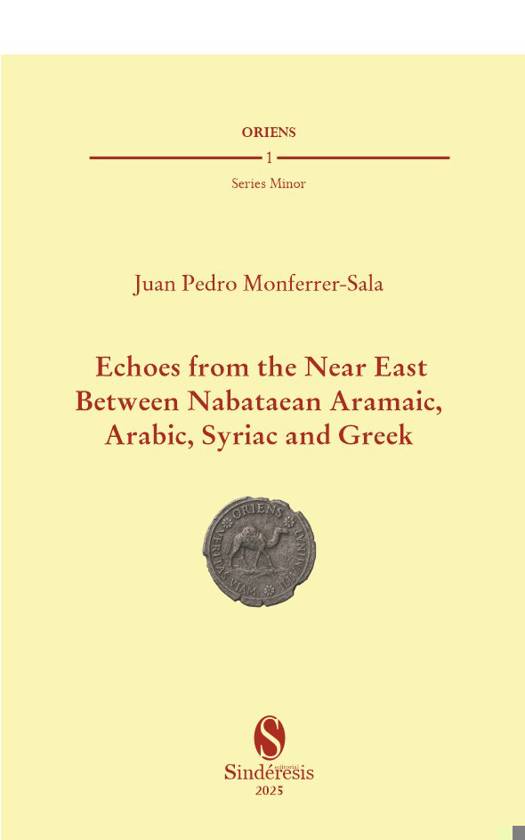
Echoes From The Near East. Between Nabataean Aramaic, Arabic, Syr
Juan Pedro Monferrer-Sala
Livre | Anglais
48,95 €
+ 97 points
Description
The three studies gathered in the present volume are intended to inaugurate a new series whose purpose is to bring together works that may contribute to the advanc ? ement of Semitic Studies in any of their manifold fields . As the number of collections devoted to such studies is exceedingly scarce ?often restricted to particular areas and, consequently, excluding others ? this new series seeks to fill that gap within the Spanish bibliographical landscape. Thus, linguistic, literary, historical, epigr ? aphic, and related studies shall all find their place within this collection, which bears the name Oriens .Of the three chapters herein presented ?all of them unpublished ? the second and third were, at different times, delivered at international conferences that, for various reasons, were never or will never be published. The second chapter of this volume was presented at the conference Monks as Translators: Translation Methods in Early Syro -Arabic Melkite Literature , held at the Freie Universität Berlin between the 10th and 20th of June, 2025. The third, on the other hand, was read as a paper at an internationa l conference held in 2008 on the occasion of the fiftieth anniversary of the National Hellenic Research Foundation (?????? ?????? ???????) in Athens (Greece) . The first of the three chapters, likewise unpublished, has not been presented at any academic gathering.When the opportunity arose to inaugurate this colle ? ction, it seemed the proper occasion to bring these studies to light , particularly the first and third, which had long lain forgotten in a drawer. Naturally, insofar as circumstances allowed, we have revised these two somewhat aged articles, introduced certain modificat ? ions, and added new references in order to bring them up to date. Though time had inevitably taken its toll, we discovered that the ideas contained therein still held potential interest for some of our colleagues. Thus, before consigning them to the eterna l sleep of oblivion, we resolved to breathe new life into them, hoping that they may yet be of value to someone.The combination of the various elements of research that converge within these three chapters, under the benevolent aegis of Philology, may ?so we trust ? serve as both an inspiration and encouragement to all those who wish to contribute to the establishment of a firm and lasting foundation, one that might preserve a legacy for fellow scholars, students, and all those with a genuine interest in a discipline now in serious peril of extinction.
Spécifications
Parties prenantes
- Auteur(s) :
- Editeur:
Contenu
- Nombre de pages :
- 138
- Langue:
- Anglais
Caractéristiques
- EAN:
- 9791387929299
- Date de parution :
- 01-04-26
- Format:
- Livre
- Dimensions :
- 160 mm x 240 mm
- Poids :
- 270 g



Seulement chez Librairie Club
+ 97 points sur votre carte client de Librairie Club
Cadeau


Les avis
Nous publions uniquement les avis qui respectent les conditions requises. Consultez nos conditions pour les avis.