


- Retrait en 2 heures
- Assortiment impressionnant
- Paiement sécurisé
- Toujours un magasin près de chez vous
- Retrait en 2 heures
- Assortiment impressionnant
- Paiement sécurisé
- Toujours un magasin près de chez vous



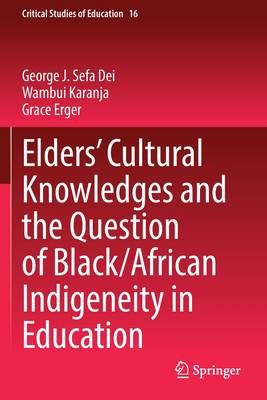
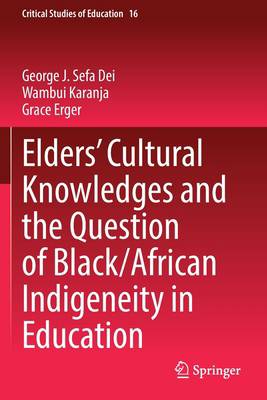
Elders' Cultural Knowledges and the Question of Black/ African Indigeneity in Education
George J Sefa Dei, Wambui Karanja, Grace Erger
151,95 €
+ 303 points
Format
Description
Chapter 1: ARTICULATING THE EPISTEMIC CHALLENGE
In this chapter, we articulate the epistemic challenge and how one responds to the challenge. We take up the assertion that, "We are all entitled to a "degree of self-centrism". However, the question is not whether non-dominant thinking [bodies of knowledge] "can reach a self-consciousness and evident neutrality", but rather, engaging such knowledge as intellectual resistance & subversion for the main purpose of "offering alternative [complementary or contradictory] visions of reality more rooted in the lived experiences" of African peoples (Dabeshi, 2014; pp. 3-4).
Chapter 2: INDIGENEITY AND THE CHALLENGE OF DECOLONIAL EDUCATION
Chapter 2 will examine counter-hegemonic knowledge production in the [Western] academy and the responsibilities of Black/Indigenous/racialized scholars coming to know and producing knowing to challenge the particularly of Western science knowledge that masquerades as universal knowledge in academia. We engage the chapter from a stance examining the coloniality of knowledge in academia, finding ways to centre Indigenous and African Elders' cultural knowledge systems in the academy as a way to disrupt Euro-colonial hegemonic knowledging. We ask: how do we challenge the 'grammar of coloniality' of Western knowledge and affirm the possibilities of a re-imagining of "new geographies" & cartographies of knowledge (Raghuram, 2017) as varied and intersecting ontologies & epistemologies that inform our human condition as "learning experiences, research and knowledge generation" practices (see Lebakeng 2010; p. 28, citing Teffo, 2002)? We take up the Mignolo and others conceptualization of 'decoloniality' drawing convergences and divergences with anti-colonial education highlighting how the claim of Indigeneity complicate such discussions in multiple geo-spaces.
Chapter 3: WHERE WE ARE COMING FROM?
In this chapter, we develop a case for where we are coming from and interrogate, noting and highlighting some issues and questions:
a) Knowledge exclusions/coloniality of 'science [e.g., what constitutes knowledge? the 'science'/Indigenous binary? etc.].
b) Is there a place for 'bodily ways of knowing' in the academy [in the search for episteme in dialogue]?
c) Primitivizing the 'Other' [e.g., the genealogies of Black/African intellectual thought].d) The resistance to claims of Black/African Indigeneity.
e) Redefining Indigenous/Indigeneity & the relationship to the question of the Land [i.e., decolonization is also about resisting 'imperial consciousness'].
f) Taking up Elders' cultural knowledges as pedagogies of social liberation?
g) African Elders' knowledge as 'sub-intern'of place/site/location & source of Indigenous cosmologies & episteme, consisting of "worldsenses" [Oyewumi, 1977] & "new geographies of knowledge" [Raghuram, 2017].
h) The 'rhetoric' and 'myth' of modernity - schooling & education deny the power of Elders' cultural knowledges as decolonial difference.
Chapter 4: ASKING QUESTIONS
In this chapter, we identify some key probing questions that guide the objectives of this book:
a) How do we come to understand African Elders' cultural knowledge as Indigenous epistemology?
b) What specific Elders' teachings relating to community, social responsibilit
Spécifications
Parties prenantes
- Auteur(s) :
- Editeur:
Contenu
- Nombre de pages :
- 226
- Langue:
- Anglais
- Collection :
- Tome:
- n° 16
Caractéristiques
- EAN:
- 9783030842031
- Date de parution :
- 05-01-23
- Format:
- Livre broché
- Format numérique:
- Trade paperback (VS)
- Dimensions :
- 156 mm x 234 mm
- Poids :
- 340 g


Seulement chez Librairie Club
+ 303 points sur votre carte client de Librairie Club
Cadeau


Les avis
Nous publions uniquement les avis qui respectent les conditions requises. Consultez nos conditions pour les avis.