


- Retrait en 2 heures
- Assortiment impressionnant
- Paiement sécurisé
- Toujours un magasin près de chez vous
- Retrait gratuit dans votre magasin Club
- 7.000.0000 titres dans notre catalogue
- Payer en toute sécurité
- Toujours un magasin près de chez vous



Description
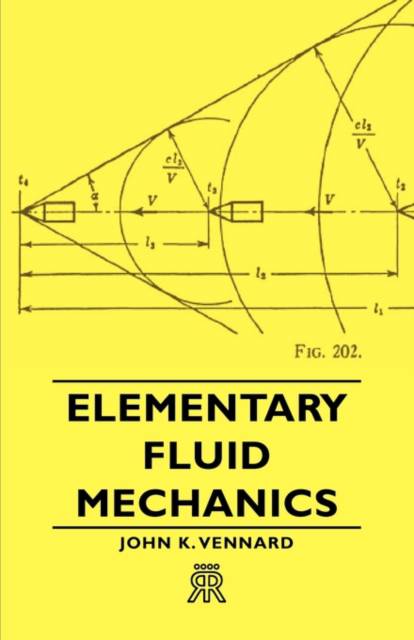
Fluid mechanics is the study under all possible conditions of rest and motion. Its approaches analytical, rational, and mathematical rather than empirical it concerns itself with those basic principles which lead to the solution of numerous diversified problems, and it seeks results which are widely applicable to similar fluid situations and not limited to isolated special cases. Fluid mechanics recognizes no arbitrary boundaries between fields of engineering knowledge but attempts to solve all fluid problems, irrespective of their occurrence or of the characteristics of the fluids involved. This textbook is intended primarily for the beginner who knows the principles of mathematics and mechanics but has had no previous experience with fluid phenomena. The abilities of the average beginner and the tremendous scope of fluid mechanics appear to be in conflict, and the former obviously determine limits beyond which it is not feasible to go these practical limits represent the boundaries of the subject which I have chosen to call elementary fluid mechanics. The apparent conflict between scope of subject and beginner ability is only along mathematical lines, however, and the physical ideas of fluid mechanics are well within the reach of the beginner in the field. Holding to the belief that physical concepts are the sine qua non of mechanics, I have sacrificed mathematical rigor and detail in developing physical pictures and in many cases have stated general laws only without numerous exceptions and limitations in order to convey basic ideas such oversimplification is necessary in introducing a new subject to the beginner. Like other courses in mechanics, fluid mechanics must include disciplinary features as well as factual information the beginner must follow theoretical developments, develop imagination in visualizing physical phenomena, and be forced to think his way through problems of theory and application. The text attempts to attain these objectives in the following ways omission of subsidiary conclusions is designed to encourage the student to come to some conclusions by himself application of bare principles to specific problems should develop ingenuity illustrative problems are included to assist in overcoming numerical difficulties and many numerical problems for the student to solve are intended not only to develop ingenuity but to show practical applications as well. Presentation of the subject begins with a discussion of fundamentals, physical properties and fluid statics. Frictionless flow is then discussed to bring out the applications of the principles of conservation of mass and energy, and of impulse-momentum law, to fluid motion. The principles of similarity and dimensional analysis are next taken up so that these principles may be used as tools in later developments. Frictional processes are discussed in a semi-quantitative fashion, and the text proceeds to pipe and open-channel flow. A chapter is devoted to the principles and apparatus for fluid measurements, and the text ends with an elementary treatment of flow about immersed objects.
Spécifications
Parties prenantes
- Auteur(s) :
- Editeur:
Contenu
- Nombre de pages :
- 368
- Langue:
- Anglais
Caractéristiques
- EAN:
- 9781406700107
- Date de parution :
- 02-08-07
- Format:
- Livre broché
- Format numérique:
- Trade paperback (VS)
- Dimensions :
- 140 mm x 216 mm
- Poids :
- 467 g


Seulement chez Librairie Club
+ 67 points sur votre carte client de Librairie Club
Cadeau

Cadeau


Les avis
Nous publions uniquement les avis qui respectent les conditions requises. Consultez nos conditions pour les avis.