


- Retrait en 2 heures
- Assortiment impressionnant
- Paiement sécurisé
- Toujours un magasin près de chez vous
- Retrait gratuit dans votre magasin Club
- 7.000.0000 titres dans notre catalogue
- Payer en toute sécurité
- Toujours un magasin près de chez vous



68,95 €
+ 137 points
Description
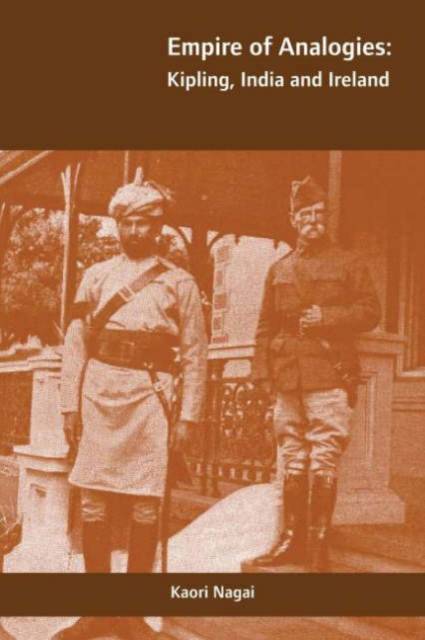
Who is Kim?" and "Why is he Irish?--This book sheds light on this post-colonial riddle by placing it within a web of colonial analogies that existed to create the British Empire as a "reality." It characterizes "Empire" as a discursive battleground in which conflicting and changing models of British hegemony coexisted and were constantly contested.
Starting from the analysis of the Irish characters in Kipling's Indian stories, this book shows that the representation of the British Empire was greatly indebted to analogies and comparisons made between colonies, and as such became the very site where the image of Empire was contested. It contrasts two different ways of making colonial analogies; "imperialist" and "nationalist." Kipling, as a young journalist, was keenly aware of the fact that Indian and Irish nationalists drew analogies between each other's colonial situation to make the case for self-government and British misrule, and his repeated emphasis on Irish participation in the Raj can be seen as a powerful "imperialist" counter-representation to these subversive analogies. With this framework in mind, this book traces how Kipling's representation of Empire changed over time as he moved away from India and also as the hegemony of British imperialism faltered toward the end of the nineteenth century. It argues that this change roughly corresponds with the transformation of Mulvaney: Kim is characteristically made voiceless as an Irish subject, who does not miss Ireland as home. Furthermore, the book shows how Kipling's new version of the white man's world, that is, of the Settler's Empire, is palimpsested onto Kim, which makes the novel radically different from his earlier representation of the Raj.
"Empire of Analogies" is primarily aimed at scholars and students who are interested in such topics as Rudyard Kipling, postcolonial literature and history, nineteenth-century Irish history and culture, British India, and the larger question of the British Empire. Scholars who are working on trans-colonial models of the British Empire, and/or the use of comparative models in postcolonial studies, would find this book particularly interesting.
"Empire of Analogies" has special relevance to courses in Colonial/Postcolonial literature and Victorian Studies, dealing with topics such as empire and literature, British India, nineteenth Irish history and diaspora, the Boer War, the Settler colonies, and transcolonialsm/nationalism. Many of these courses list Rudyard Kipling's "Kim" as one of the main texts.
Starting from the analysis of the Irish characters in Kipling's Indian stories, this book shows that the representation of the British Empire was greatly indebted to analogies and comparisons made between colonies, and as such became the very site where the image of Empire was contested. It contrasts two different ways of making colonial analogies; "imperialist" and "nationalist." Kipling, as a young journalist, was keenly aware of the fact that Indian and Irish nationalists drew analogies between each other's colonial situation to make the case for self-government and British misrule, and his repeated emphasis on Irish participation in the Raj can be seen as a powerful "imperialist" counter-representation to these subversive analogies. With this framework in mind, this book traces how Kipling's representation of Empire changed over time as he moved away from India and also as the hegemony of British imperialism faltered toward the end of the nineteenth century. It argues that this change roughly corresponds with the transformation of Mulvaney: Kim is characteristically made voiceless as an Irish subject, who does not miss Ireland as home. Furthermore, the book shows how Kipling's new version of the white man's world, that is, of the Settler's Empire, is palimpsested onto Kim, which makes the novel radically different from his earlier representation of the Raj.
"Empire of Analogies" is primarily aimed at scholars and students who are interested in such topics as Rudyard Kipling, postcolonial literature and history, nineteenth-century Irish history and culture, British India, and the larger question of the British Empire. Scholars who are working on trans-colonial models of the British Empire, and/or the use of comparative models in postcolonial studies, would find this book particularly interesting.
"Empire of Analogies" has special relevance to courses in Colonial/Postcolonial literature and Victorian Studies, dealing with topics such as empire and literature, British India, nineteenth Irish history and diaspora, the Boer War, the Settler colonies, and transcolonialsm/nationalism. Many of these courses list Rudyard Kipling's "Kim" as one of the main texts.
Spécifications
Parties prenantes
- Auteur(s) :
- Editeur:
Contenu
- Nombre de pages :
- 300
- Langue:
- Anglais
Caractéristiques
- EAN:
- 9781859184080
- Date de parution :
- 28-02-07
- Format:
- Livre relié
- Format numérique:
- Genaaid
- Dimensions :
- 165 mm x 235 mm
- Poids :
- 467 g


Seulement chez Librairie Club
+ 137 points sur votre carte client de Librairie Club
Cadeau

Cadeau


Les avis
Nous publions uniquement les avis qui respectent les conditions requises. Consultez nos conditions pour les avis.