


- Retrait en 2 heures
- Assortiment impressionnant
- Paiement sécurisé
- Toujours un magasin près de chez vous
- Retrait en 2 heures
- Assortiment impressionnant
- Paiement sécurisé
- Toujours un magasin près de chez vous



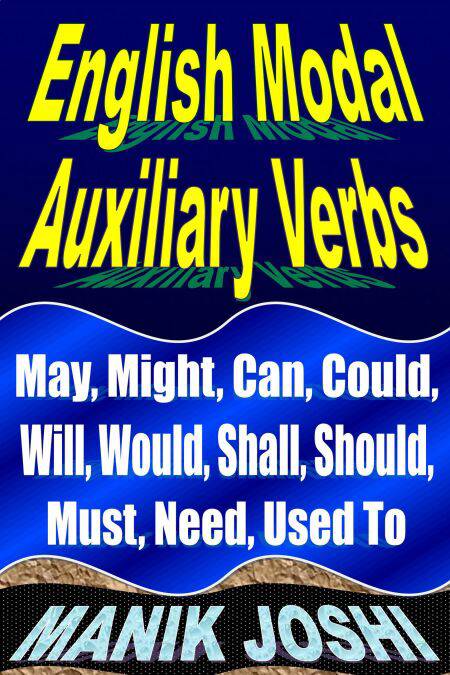
English Modal Auxiliary Verbs: May, Might, Can, Could, Will, Would, Shall, Should, Must, Need, Used To EBOOK
English Daily Use, #20
Manik Joshi
2,99 €
+ 2 points
Description
Modal Auxiliary Verb (or 'Modal Verb' or 'Modal Auxiliary') is a verb that is used with another verb (not a modal verb) to express ability, intention, necessity, obligation, permission, possibility, probability, etc.
English modal auxiliary verbs - may, might, can, could, will, would, shall, should, must, need, used(to), ought(to), dare | different patterns and examples | may and might are used to express- possibility, compulsion, obligation, probability (in the present and future) | can, could are used to express- ability, probability, possibility, suggestion, request, condition | will, would are used to express- action in future, present habit, compulsion, obligation | shall, should are used to express- action in future, suggestion, surprise, importance or purpose | need is used to express necessity | used(to) is used to express- past habit | ought(to) is used to express- probability, recommendation, obligation, advise | dare is used to express– be brave enough to
Sample This:
Modal Auxiliary Verb -- May and Might
Uses of 'May' and 'Might'
(1). Possibility/Probability
It may rain the day after tomorrow. [= Perhaps it will rain the day after tomorrow. OR It is possible that it will rain the day after tomorrow.]
He may have caught the train. [= Perhaps he caught the train. OR It is possible that he caught the train.]
(2). To say what the purpose of something is
Many people flatter that they may win favor. [= Many people flatter in order to win favor.]
They ran so that they might arrive in time. [= They ran in order to arrive in time.]
(3). To admit that something is true before introducing another point, argument, etc.
It may not be wise, but using force may be lawful. [= Although it is not wise, using force may be lawful.]
(4). To express wishes and hopes
May you live prosperous life!
May you have a good time!
My teacher blessed me that I might succeed in my exams.
(5). To give or refuse Permission [In Informal and Polite Way]
You may not withdraw money from your bank account. [= You are not allowed to withdraw money from your bank account.]
(6). To seek Permission [In Informal and Polite Way]
May I borrow your book for two days? (Yes, you may.)
May I come in? (No, you may not.)
Difference between 'May' and 'Might'
'Might' is the past equivalent of 'may' in indirect speech. 'Might' is very polite and formal. It is not common. It is mostly used in indirect questions.
I wonder if I might work on your computer.
But it is used in the same way as 'may' to talk about the present or future.
'Might' is used as a less positive version of 'May'
'May' denotes more possibility/probability
'Might' denotes less possibility/probability
May I use your mobile phone?
Might I use your mobile phone? (= A diffident way of saying 'May I use your mobile phone?')
'Might' also denotes 'would perhaps'
You might attract President's attention later. [= Perhaps you would attract.]
He might have to go [= Perhaps he had to go.]
'Might' is also used to express a degree of dissatisfaction or reproach; as,
You might pick up an argument with him!
You might have picked up an argument with him!
'Might' has limitations while 'asking permission'
Note: Avoid using 'might' to seek or give permission. [Prefer to use 'may'] | Avoid using 'might not' to refuse permission. [Prefer to use 'may not']. Using 'might' to seek or give permission is very formal and is not used very often.
Might I ask your address?
Might I offer you something to eat?
[Exception: You can use 'might' to give permission or 'might not' to refuse permission in "indirect speech"]
He asked me whether he might stay in my house.
Note: 'Maybe' is an adverb. ['Maybe' means 'perhaps'] -- Maybe he came to know something secret and was ...
Spécifications
Parties prenantes
- Auteur(s) :
- Editeur:
Contenu
- Langue:
- Anglais
- Collection :
Caractéristiques
- EAN:
- 9781301447329
- Date de parution :
- 04-02-13
- Format:
- Ebook
- Protection digitale:
- /
- Format numérique:
- ePub


Seulement chez Librairie Club
+ 2 points sur votre carte client de Librairie Club
Cadeau


Les avis
Nous publions uniquement les avis qui respectent les conditions requises. Consultez nos conditions pour les avis.