


- Retrait en 2 heures
- Assortiment impressionnant
- Paiement sécurisé
- Toujours un magasin près de chez vous
- Retrait en 2 heures
- Assortiment impressionnant
- Paiement sécurisé
- Toujours un magasin près de chez vous



80,95 €
+ 161 points
Description
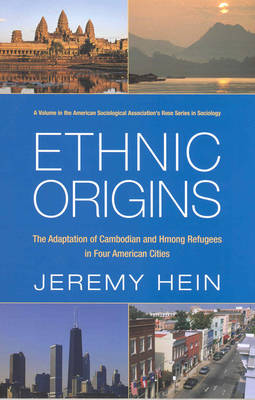
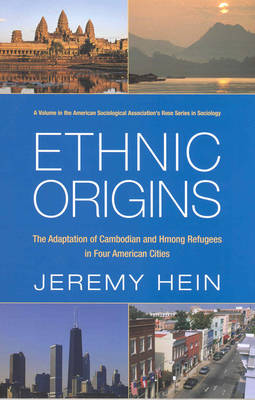
Immigration studies have increasingly focused on how immigrant adaptation to their new homelands is influenced by the social structures in the sending society, particularly its economy. Less scholarly research has focused on the ways that the cultural make-up of immigrant homelands influences their adaptation to life in a new country. In Ethnic Origins, Jeremy Hein investigates the role of religion, family, and other cultural factors on immigrant incorporation into American society by comparing the experiences of two little-known immigrant groups living in four different American cities not commonly regarded as immigrant gateways. Ethnic Origins provides an in-depth look at Hmong and Khmer refugees--people who left Asia as a result of failed U.S. foreign policy in their countries. These groups share low socio-economic status, but are vastly different in their norms, values, and histories. Hein compares their experience in two small towns--Rochester, Minnesota and Eau Claire, Wisconsin--and in two big cities--Chicago and Milwaukee--and examines how each group adjusted to these different settings. The two groups encountered both community hospitality and narrow-minded hatred in the small towns, contrasting sharply with the cold anonymity of the urban pecking order in the larger cities. Hein finds that for each group, their ethnic background was more important in shaping adaptation patterns than the place in which they settled. Hein shows how, in both the cities and towns, the Hmong's sharply drawn ethnic boundaries and minority status in their native land left them with less affinity for U.S. citizenship or "Asian American" panethnicity than the Khmer, whose ethnic boundary is more porous. Their differing ethnic backgrounds also influenced their reactions to prejudice and discrimination. The Hmong, with a strong group identity, perceived greater social inequality and supported collective political action to redress wrongs more than the individualistic Khmer, who tended to view personal hardship as a solitary misfortune, rather than part of a larger-scale injustice. Examining two unique immigrant groups in communities where immigrants have not traditionally settled, Ethnic Origins vividly illustrates the factors that shape immigrants' response to American society and suggests a need to refine prevailing theories of immigration. Hein's book is at once a novel look at a little-known segment of America's melting pot and a significant contribution to research on Asian immigration to the United States. A Volume in the American Sociological Association's Rose Series in Sociology
Spécifications
Parties prenantes
- Auteur(s) :
- Editeur:
Contenu
- Nombre de pages :
- 335
- Langue:
- Anglais
- Collection :
Caractéristiques
- EAN:
- 9780871543363
- Date de parution :
- 01-05-06
- Format:
- Livre relié
- Format numérique:
- Genaaid
- Dimensions :
- 162 mm x 236 mm
- Poids :
- 630 g


Seulement chez Librairie Club
+ 161 points sur votre carte client de Librairie Club
Cadeau


Les avis
Nous publions uniquement les avis qui respectent les conditions requises. Consultez nos conditions pour les avis.