


En raison d'une grève chez bpost, des retards de livraison peuvent survenir. Besoin de quelque chose en urgence ? Optez pour un retrait en magasin ou rendez-vous dans une Librairie Club à proximité.
- Retrait en 2 heures
- Assortiment impressionnant
- Paiement sécurisé
- Toujours un magasin près de chez vous
En raison d'une grève chez bpost, des retards de livraison peuvent survenir. Besoin de quelque chose en urgence ? Optez pour un retrait en magasin ou rendez-vous dans une Librairie Club à proximité.
- Retrait en 2 heures
- Assortiment impressionnant
- Paiement sécurisé
- Toujours un magasin près de chez vous



54,45 €
Description
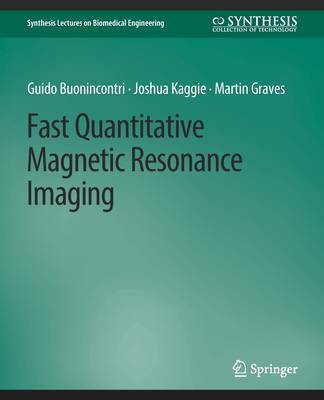
Among medical imaging modalities, magnetic resonance imaging (MRI) stands out for its excellent soft-tissue contrast, anatomical detail, and high sensitivity for disease detection. However, as proven by the continuous and vast effort to develop new MRI techniques, limitations and open challenges remain. The primary source of contrast in MRI images are the various relaxation parameters associated with the nuclear magnetic resonance (NMR) phenomena upon which MRI is based. Although it is possible to quantify these relaxation parameters (qMRI) they are rarely used in the clinic, and radiological interpretation of images is primarily based upon images that are relaxation time weighted. The clinical adoption of qMRI is mainly limited by the long acquisition times required to quantify each relaxation parameter as well as questions around their accuracy and reliability. More specifically, the main limitations of qMRI methods have been the difficulty in dealing with the high inter-parameter correlations and a high sensitivity to MRI system imperfections.
Recently, new methods for rapid qMRI have been proposed. The multi-parametric models at the heart of these techniques have the main advantage of accounting for the correlations between the parameters of interest as well as system imperfections. This holistic view on the MR signal makes it possible to regress many individual parameters at once, potentially with a higher accuracy. Novel, accurate techniques promise a fast estimation of relevant MRI quantities, including but not limited to longitudinal (T1) and transverse (T2) relaxation times. Among these emerging methods, MR Fingerprinting (MRF), synthetic MR (syMRI or MAGIC), and T1‒T2 Shuffling are making their way into the clinical world at a very fast pace. However, the main underlying assumptions and algorithms used are sometimes different from those found in the conventional MRI literature, and can be elusive at times. In this book, we take the opportunity to study and describe the main assumptions, theoretical background, and methods that are the basis of these emerging techniques.
Quantitative transient state imaging provides an incredible, transformative opportunity for MRI. There is huge potential to further extend the physics, in conjunction with the underlying physiology, toward a better theoretical description of the underlying models, their application, and evaluation to improve the assessment of disease and treatment efficacy.
Spécifications
Parties prenantes
- Auteur(s) :
- Editeur:
Contenu
- Nombre de pages :
- 124
- Langue:
- Anglais
- Collection :
Caractéristiques
- EAN:
- 9783031005398
- Date de parution :
- 19-02-20
- Format:
- Livre broché
- Format numérique:
- Trade paperback (VS)
- Dimensions :
- 190 mm x 235 mm
- Poids :
- 258 g


Seulement chez Librairie Club
Cadeau


Les avis
Nous publions uniquement les avis qui respectent les conditions requises. Consultez nos conditions pour les avis.