


- Retrait en 2 heures
- Assortiment impressionnant
- Paiement sécurisé
- Toujours un magasin près de chez vous
- Retrait en 2 heures
- Assortiment impressionnant
- Paiement sécurisé
- Toujours un magasin près de chez vous



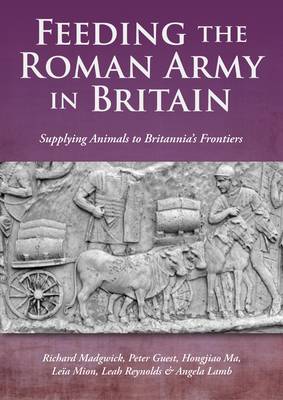
Feeding the Roman Army in Britain
Isotopes and the Provisioning of Animals to Britannia's Frontiers
Richard Madgwick, Peter Guest, Hongjiao Ma, Leïa Mion, Leah Reynolds, Angela Lamb
Livre broché | Anglais
138,95 €
+ 277 points
Description
Analyzes how Roman Britain's frontiers were provisioned, revealing animal supply networks and agricultural strategies supporting the army.
This volume presents the results of the Leverhulme Trust-funded project 'Feeding the Roman Army in Britain' (FRAB) - an ambitious interdisciplinary project that has transformed understanding of the supply networks and husbandry strategies that provisioned the army on Britannia's frontiers.
Rome's success as an ancient superpower ultimately depended on the capacity to deploy and maintain large numbers of professional soldiers in static defensive frontier garrisons. Until recently we had only limited understanding of how the logistical challenges of supplying these frontiers were met, or the impact this had on frontier provinces and their populations. These themes are at the forefront of Roman studies and FRAB provides, for the first time, a more sophisticated understanding of the British frontiers as economic as well as militarised zones.
Employing a groundbreaking programme of multi-isotope analysis, FRAB focuses on the production and supply of cattle, sheep/goats and pigs in Roman Britain's frontier regions: South Wales, Hadrian's Wall and the Antonine Wall.
The project's objectives are to:
- identify the supply networks to forts and fortresses on the frontiers by establishing the origins of the main taxa consumed;
- reconstruct animal and landscape management strategies (i.e. manuring, foddering regimes and diet), and investigate evidence for agricultural intensification and/or extensification to meet the needs of the Roman army;
- explore chronological variation in supply and animal management, to establish if and how frontier supply changed over time.
Cattle, sheep/goats and pigs were examined from 15 target sites in the three frontier regions, producing the largest faunal multi-isotope dataset yet delivered globally. Analysis concentrated on material from early occupation phases to explore the supply networks that fed the Roman army's appetite for animals and animal products in the decades after the frontiers were established. These sites include legionary fortresses, auxiliary forts, supply bases, as well as selected rural settlements, bringing together, for the first time, two key categories of Romano-British settlements - military and rural - to examine how these sites (and landscapes) were connected.
Four isotope systems were employed to provide evidence for animal origins and supply networks (strontium [87Sr/86Sr] and sulfur [δ34S]), and management strategies (carbon [δ13C] and nitrogen [δ15N]). This is the first project of this type to integrate archaeological, historical and scientific methods, while also connecting university research with (under-utilised) museum collections.
After describing the background to the project and overviews of previous research on the provisioning of the Roman army, the results of the multi-isotope analytical programme are presented, which are followed by in-depth discussions of the project's main research objectives.
This volume presents the results of the Leverhulme Trust-funded project 'Feeding the Roman Army in Britain' (FRAB) - an ambitious interdisciplinary project that has transformed understanding of the supply networks and husbandry strategies that provisioned the army on Britannia's frontiers.
Rome's success as an ancient superpower ultimately depended on the capacity to deploy and maintain large numbers of professional soldiers in static defensive frontier garrisons. Until recently we had only limited understanding of how the logistical challenges of supplying these frontiers were met, or the impact this had on frontier provinces and their populations. These themes are at the forefront of Roman studies and FRAB provides, for the first time, a more sophisticated understanding of the British frontiers as economic as well as militarised zones.
Employing a groundbreaking programme of multi-isotope analysis, FRAB focuses on the production and supply of cattle, sheep/goats and pigs in Roman Britain's frontier regions: South Wales, Hadrian's Wall and the Antonine Wall.
The project's objectives are to:
- identify the supply networks to forts and fortresses on the frontiers by establishing the origins of the main taxa consumed;
- reconstruct animal and landscape management strategies (i.e. manuring, foddering regimes and diet), and investigate evidence for agricultural intensification and/or extensification to meet the needs of the Roman army;
- explore chronological variation in supply and animal management, to establish if and how frontier supply changed over time.
Cattle, sheep/goats and pigs were examined from 15 target sites in the three frontier regions, producing the largest faunal multi-isotope dataset yet delivered globally. Analysis concentrated on material from early occupation phases to explore the supply networks that fed the Roman army's appetite for animals and animal products in the decades after the frontiers were established. These sites include legionary fortresses, auxiliary forts, supply bases, as well as selected rural settlements, bringing together, for the first time, two key categories of Romano-British settlements - military and rural - to examine how these sites (and landscapes) were connected.
Four isotope systems were employed to provide evidence for animal origins and supply networks (strontium [87Sr/86Sr] and sulfur [δ34S]), and management strategies (carbon [δ13C] and nitrogen [δ15N]). This is the first project of this type to integrate archaeological, historical and scientific methods, while also connecting university research with (under-utilised) museum collections.
After describing the background to the project and overviews of previous research on the provisioning of the Roman army, the results of the multi-isotope analytical programme are presented, which are followed by in-depth discussions of the project's main research objectives.
Spécifications
Parties prenantes
- Auteur(s) :
- Editeur:
Contenu
- Nombre de pages :
- 240
- Langue:
- Anglais
Caractéristiques
- EAN:
- 9798888572542
- Date de parution :
- 16-12-26
- Format:
- Livre broché
- Format numérique:
- Trade paperback (VS)
- Dimensions :
- 216 mm x 279 mm


Seulement chez Librairie Club
+ 277 points sur votre carte client de Librairie Club
Cadeau

Cadeau


Les avis
Nous publions uniquement les avis qui respectent les conditions requises. Consultez nos conditions pour les avis.