


- Retrait en 2 heures
- Assortiment impressionnant
- Paiement sécurisé
- Toujours un magasin près de chez vous
- Retrait en 2 heures
- Assortiment impressionnant
- Paiement sécurisé
- Toujours un magasin près de chez vous



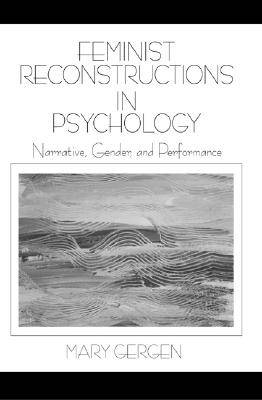
Feminist Reconstructions in Psychology
Narrative, Gender, and Performance
Mary Gergen
Livre broché | Anglais
192,45 €
+ 384 points
Description
Feminist Reconstructions in Psychology introduces a distinctive new mode of doing psychology. This psychology is based on an increasingly popular range of ideas called social constructionism. Within the book, new forms of theory and methods of inquiry relating social constructionism to feminist topics are introduced. Each chapter highlights different topics of special concern within gender studies, especially the psychology of women.
The first chapter outlines the purposes of the book and positions social constructionism in relation to the more traditional "feminist psychologies" empiricist and feminist standpoint. Given the trend toward social constructionism, [the author thinks] the broad audience of people doing gender work will be interested in becoming familiar with this approach to the field. The second and third chapters are focused on narrative methods as a means for studying gender differences in popular autobiographies. The discussions center on differences in stories of achievement, family, love, and embodiment. Quotations from well-known personalities, such as Donald Trump and Martina Navratilova, enrich the text.
The fourth, fifth, and sixth chapters involve issues of menopause with a focus group methodology, a historical look at the "male gaze" as it is poised on the Naked Maja painting by Goya, and how relationships function within imaginal conversations.
The two final chapters in the book are exemplars of a recent innovation in the field called performative psychology. One monologue is about aging in contemporary society and the other is a feminist critique of aspects of postmodernism itself.
The book draws from the central tenets of postmodern inquiry, as played out in the positive framework of social constructionism. Emphasized are reflexivity, the social basis of reality making, the breakdown of traditional narrative forms, the loss of objectivity as a scientific standard, and the possibilities for new forms of doing research. In this respect, the book is unique and serves to provide a point of view on an intriguing movement that is gaining momentum across the social sciences and humanities. It is hoped that this book might serve as a catalyst for further innovative work in psychology. This text encourages such moves by its own irreverence for traditions and its overt efforts to break down resistances to creativity in the field.
The first chapter outlines the purposes of the book and positions social constructionism in relation to the more traditional "feminist psychologies" empiricist and feminist standpoint. Given the trend toward social constructionism, [the author thinks] the broad audience of people doing gender work will be interested in becoming familiar with this approach to the field. The second and third chapters are focused on narrative methods as a means for studying gender differences in popular autobiographies. The discussions center on differences in stories of achievement, family, love, and embodiment. Quotations from well-known personalities, such as Donald Trump and Martina Navratilova, enrich the text.
The fourth, fifth, and sixth chapters involve issues of menopause with a focus group methodology, a historical look at the "male gaze" as it is poised on the Naked Maja painting by Goya, and how relationships function within imaginal conversations.
The two final chapters in the book are exemplars of a recent innovation in the field called performative psychology. One monologue is about aging in contemporary society and the other is a feminist critique of aspects of postmodernism itself.
The book draws from the central tenets of postmodern inquiry, as played out in the positive framework of social constructionism. Emphasized are reflexivity, the social basis of reality making, the breakdown of traditional narrative forms, the loss of objectivity as a scientific standard, and the possibilities for new forms of doing research. In this respect, the book is unique and serves to provide a point of view on an intriguing movement that is gaining momentum across the social sciences and humanities. It is hoped that this book might serve as a catalyst for further innovative work in psychology. This text encourages such moves by its own irreverence for traditions and its overt efforts to break down resistances to creativity in the field.
Spécifications
Parties prenantes
- Auteur(s) :
- Editeur:
Contenu
- Nombre de pages :
- 240
- Langue:
- Anglais
Caractéristiques
- EAN:
- 9780761911517
- Date de parution :
- 13-04-01
- Format:
- Livre broché
- Format numérique:
- Trade paperback (VS)
- Dimensions :
- 167 mm x 234 mm
- Poids :
- 331 g


Seulement chez Librairie Club
+ 384 points sur votre carte client de Librairie Club
Cadeau


Les avis
Nous publions uniquement les avis qui respectent les conditions requises. Consultez nos conditions pour les avis.