


- Retrait en 2 heures
- Assortiment impressionnant
- Paiement sécurisé
- Toujours un magasin près de chez vous
- Retrait en 2 heures
- Assortiment impressionnant
- Paiement sécurisé
- Toujours un magasin près de chez vous



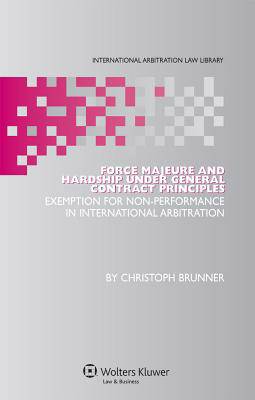
Force Majeure and Hardship Under General Contract Principles
Exemption for Non-Performance in International Arbitration
Christoph Brunner
189,95 €
+ 379 points
Description
Lawyers involved in international commercial transactions know well that unforeseen events affecting the performance of a party often arise. Not surprisingly, exemptions for non-performance are dealt with in a significant number of arbitral awards. This very useful book thoroughly analyzes contemporary approaches, particularly as manifested in case law, to the scope and content of the principles of exemption for non-performance which are commonly referred to as 'force majeure' and 'hardship.' The author shows that the 'general principles of law' approach addresses this concern most effectively. Generally accepted and understood by the business world at large, this approach encompasses principles of international commercial contracts derived from a variety of legal systems. It's most important 'restatements' are found in the 1980 United Nations Convention on Contracts for the International Sale of Goods (CISG) and the UNIDROIT Principles of International Commercial Contracts (UPICC). Establishing specific standards and "case groups" for the exemptions under review, the analysis treats such recurring elements as the following: contractual risk allocations; unforeseeability of an impediment; impediments beyond the typical sphere of risk and control of the obligor; responsibility for third parties (subcontractors, suppliers); legal impediments (acts of public authority) and effect of mandatory rules; involvement of states or state enterprises; interpretation of force majeure and hardship clauses; hardship threshold test; frustration of purpose; irreconcilable differences; comparison with exemptions under domestic legal systems (impossibility of performance, frustration of contract, impracticability) The book is a major contribution to the development of the use of general principles of law in international commercial arbitration. It may be used as a comprehensive commentary on the force majeure and hardship provisions of the UPICC, as well as on Art. 79 of the CISG. In addition, as an insightful investigation into the fundamental question of the limits of the principle of sanctity of contracts, this book is sure to capture the attention of business lawyers and interested academics everywhere.
Spécifications
Parties prenantes
- Auteur(s) :
- Editeur:
Contenu
- Nombre de pages :
- 624
- Langue:
- Anglais
- Collection :
- Tome:
- n° 18
Caractéristiques
- EAN:
- 9789041127921
- Date de parution :
- 23-12-08
- Format:
- Livre relié
- Format numérique:
- Genaaid
- Dimensions :
- 156 mm x 234 mm
- Poids :
- 1043 g


Seulement chez Librairie Club
+ 379 points sur votre carte client de Librairie Club
Cadeau


Les avis
Nous publions uniquement les avis qui respectent les conditions requises. Consultez nos conditions pour les avis.